How Fast Can Humpback Whales Swim Speed and Movement Explained
Humpback whales are among the ocean’s most recognizable marine mammals. Their enormous bodies, long pectoral fins, and powerful tail flukes help them travel through the sea, change direction, and perform spectacular movements at the surface. But exactly how fast can humpback whales swim?
Humpback whales generally cruise at a moderate pace, conserving energy as they move through the ocean. When necessary, they can swim faster for short periods, although their speed varies with their activity, physical condition, and surroundings. There is no single speed that describes every humpback whale in every situation.
For visitors joining a whale-watching excursion in Samaná Bay, in the Dominican Republic, understanding whale movement can make an encounter more interesting. It helps explain why a whale may surface nearby, disappear beneath the water, or move away before a boat has much time to observe it.
In this guide, we explore humpback whale swimming speed, how these animals propel themselves, why they change pace, and what their movements can reveal during a responsible whale-watching trip.
How Fast Can Humpback Whales Swim?
Humpback whales are not built to maintain maximum speed constantly. Instead, they use different swimming speeds depending on what they are doing.
During ordinary travel, they often move at a relatively relaxed pace. They may accelerate when responding to a disturbance, interacting with other whales, or performing particular behaviors. Exact speeds vary among individuals and situations, and reported figures should be treated as approximate rather than universal.
It is useful to distinguish three types of movement:
- Cruising: Steady swimming over longer distances while conserving energy.
- Short bursts: Faster movement for a limited period when circumstances require it.
- Surface activity: Movements such as breaching or forceful turns that are not simply measures of sustained swimming speed.
A whale that launches itself partly or almost entirely out of the water may appear extremely fast. However, a breach is a brief, energetic behavior and should not be confused with the animal’s usual swimming pace.
What Determines a Humpback Whale’s Speed?
Several factors influence how quickly a humpback whale moves through the water.
1. The whale’s activity
A whale traveling steadily may move differently from one turning, interacting with another whale, or engaging in active surface behavior. Movement depends on what the animal is doing at that moment.
2. Energy conservation
Humpback whales migrate over long distances between feeding areas and breeding grounds. Efficient movement helps them travel without unnecessarily wasting energy.
They do not need to swim at their fastest possible pace throughout a journey. A sustainable rhythm is more useful for long-distance travel than continuous acceleration.
3. Ocean conditions
Currents, waves, and other environmental conditions can affect how an animal moves through the water. A whale swimming against a current may make less progress over the seabed than one moving with a favorable current.
This distinction matters because swimming speed through the water is not always the same as speed relative to the shoreline.
4. Social interactions
Humpback whales sometimes travel individually and sometimes appear in pairs or temporary groups. Their movements may change during interactions with other whales.
Observers should avoid assuming that a change in speed has one definite explanation. Without more information, it is difficult to determine why a particular whale accelerates, slows down, or changes direction.
5. Age and physical condition
A whale’s size, age, health, and individual behavior can influence its movement. A young calf may not move in exactly the same way as a mature adult.
Even whales of similar size may behave differently depending on their circumstances.
How Do Humpback Whales Move Through the Water?
Humpback whales use powerful muscles and a flexible body to propel themselves forward. Their movement is different from the side-to-side tail motion commonly associated with many fish.
The powerful tail flukes
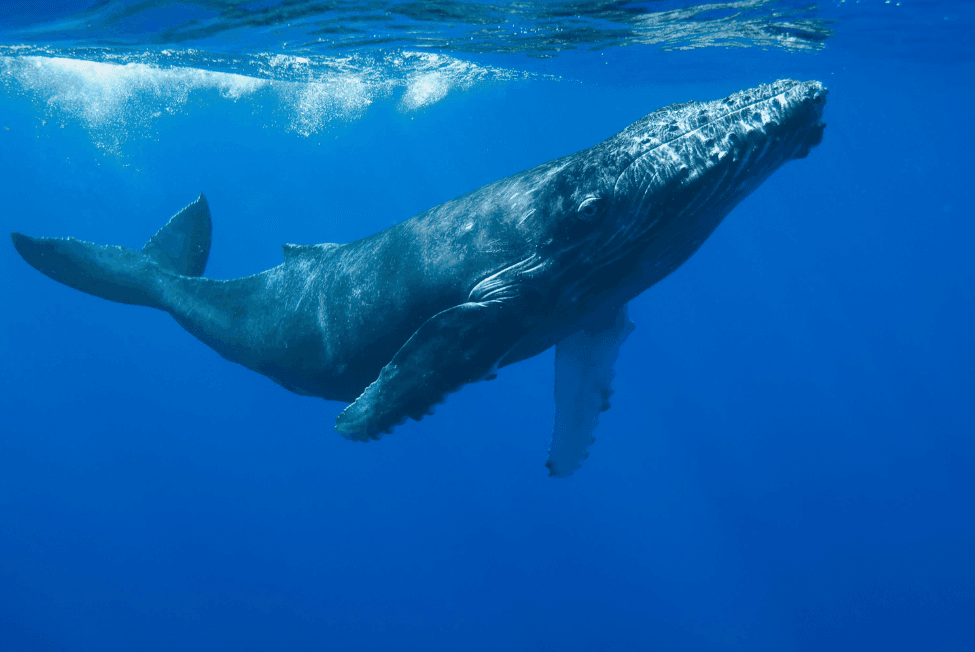
The tail flukes are central to a humpback whale’s propulsion. The whale moves its tail up and down, pushing water backward and helping its large body move forward.
A strong tail stroke can also help the animal accelerate or change its movement. From a boat, observers may sometimes see the tail emerge above the surface before the whale dives.
Not every dive includes a visible tail lift. Whether the flukes appear depends on the whale’s angle, depth, and movement.
The long pectoral fins
Humpback whales have exceptionally long pectoral fins compared with many other whale species. These fins help with steering, balance, and maneuvering.
Their shape and flexibility contribute to the whale’s ability to make controlled turns. This is important for an animal that may need to change direction while swimming, feeding, or interacting with other whales.
The body and streamlined shape
Although humpback whales are large, their bodies are adapted for movement through water. Their shape allows them to travel through the ocean while their muscles and fins control propulsion and direction.
Water creates resistance, so moving faster requires additional effort. This is one reason that a short burst of speed is different from maintaining a high pace over a long distance.
Can Humpback Whales Swim Faster Than Boats?
The answer depends on the boat, the whale’s behavior, and the conditions.
A whale may move away from a slow-moving vessel, change direction, or briefly accelerate. However, it would be misleading to claim that humpback whales always swim faster than boats or that they cannot be overtaken under any circumstances.
Boat speed is also not the right measure for deciding how close a vessel should approach a whale. Responsible whale watching prioritizes wildlife protection and applicable regulations rather than attempting to keep pace with an animal.
In Samaná Bay, visitors should choose a responsible operator that follows local rules and does not chase, crowd, or deliberately pressure whales to change their direction.
Why Might a Humpback Whale Suddenly Speed Up?
A sudden change in movement can be fascinating to observe, but it does not always have an obvious explanation.
Possible reasons include:
- The whale is changing its travel direction.
- It is responding to the movements of another whale.
- It is performing a brief burst of active movement.
- It is diving or repositioning itself underwater.
- Environmental conditions are influencing its path.
These are possibilities, not definitive diagnoses of a whale’s behavior. A single observation usually does not reveal exactly what the animal is thinking or why it moved in a particular way.
Visitors should watch the overall pattern of movement rather than trying to assign a specific meaning to every turn or tail stroke.
How Swimming Speed Affects Whale Watching in Samaná Bay
Samaná Bay is well known as a seasonal destination for observing migrating North Atlantic humpback whales. During the winter breeding season, visitors may see whales surfacing, diving, traveling, and occasionally displaying energetic surface behaviors.
Swimming speed can affect how long a whale remains visible from a boat. A whale may surface, breathe, and dive again, leaving observers to wait for its next appearance. Another may travel in a direction that gradually takes it farther from view.
This is normal wildlife behavior. A tour cannot guarantee that a whale will remain beside a vessel or appear at a particular distance.
Why whales disappear underwater
When a whale dives, it may continue swimming below the surface. Its next surfacing point can be difficult to predict because the animal’s path and dive duration vary.
A whale that disappears from view has not necessarily left the area. It may simply be underwater, beyond the observer’s line of sight.
What visitors should look for
Rather than focusing only on speed, look for different movement patterns:
- A steady forward path that suggests the whale is traveling.
- A change in direction as the animal moves through the water.
- A dive followed by a later surfacing.
- A visible tail lift before some deeper dives.
- Brief bursts of surface activity, when they occur naturally.
These observations can help visitors appreciate the whale without needing to estimate its speed precisely.
Is a Humpback Whale’s Breach a Sign of High Swimming Speed?
Not necessarily.
Breaching occurs when a whale propels part or much of its body out of the water. The behavior involves considerable force and energy, but a breach alone does not tell an observer the whale’s sustained swimming speed.
Humpback whales may breach for different reasons, and scientists do not always know the purpose of an individual breach. It is better to describe what is visible than to assume a single explanation.
For visitors, a breach can be a memorable sight. However, whales may spend an entire observation period swimming or diving without breaching at all.
How Far Can Humpback Whales Travel?
Humpback whales are known for long seasonal migrations between high-latitude feeding grounds and warmer breeding areas. Their journeys can cover thousands of miles, depending on the population and route.
These migrations are not continuous races at maximum speed. Whales move according to their needs and environmental conditions, balancing travel with other activities.
Samaná Bay is part of the breeding-season experience for North Atlantic humpback whales. Many of the whales seen in the region are associated with the broader seasonal migration between northern feeding grounds and Caribbean breeding waters.
Their ability to cover long distances highlights why efficient swimming matters as much as short bursts of speed.
Can You Estimate a Whale’s Speed From a Tour Boat?
It is difficult to estimate a whale’s true swimming speed simply by watching it from a moving boat.
Several factors make visual estimates unreliable:
- The boat itself may be moving.
- The whale may be swimming at an angle relative to the vessel.
- The animal can dive and continue traveling out of sight.
- Waves and currents can affect apparent movement.
- The observer may not know the distance the whale has traveled.
Accurate speed estimates require suitable measurements and a reliable reference frame. A casual sighting is better used to observe general movement than to produce a precise speed figure.
If you are on a whale-watching excursion, listen to your guide’s explanations and enjoy observing the whale’s natural behavior rather than trying to time or follow it.
Responsible Whale Watching Matters More Than Speed
A whale’s movement should always take priority over a visitor’s desire for a closer look or a better photograph.
When choosing a Samaná whale-watching excursion, consider whether the operator explains responsible viewing practices and follows applicable wildlife regulations.
During an encounter:
- Never encourage a boat operator to chase a whale.
- Do not ask the captain to cut across a whale’s path.
- Follow the guide’s safety instructions.
- Avoid loud or disruptive behavior.
- Use a zoom lens instead of insisting on getting closer.
- Respect the whale’s ability to move away or dive.
These practices help create a better experience for visitors while respecting the animals and their environment.
Frequently Asked Questions
How fast can humpback whales swim?
Humpback whales generally travel at moderate speeds and can accelerate for short periods. Their exact speed depends on their activity, surroundings, and individual circumstances, so a single figure should not be treated as universal.
Do humpback whales swim quickly when they migrate?
They can cover long distances during seasonal migrations, but migration does not mean they swim at maximum speed continuously. Efficient, sustained movement is important during long journeys.
Can a humpback whale outrun a tourist boat?
It depends on the whale’s movement and the vessel’s speed. Some whales may accelerate or move away from a boat, but there is no universal answer that applies to every encounter.
Why do humpback whales move their tails up and down?
Their tail flukes generate propulsion by pushing water backward. The tail also contributes to acceleration and other movements.
Why does a whale disappear after surfacing?
A whale may dive and continue swimming underwater. Its next surfacing location can be difficult to predict, so it may not reappear exactly where observers expect.
Can I see humpback whales swimming in Samaná Bay?
Samaná Bay is a well-known seasonal whale-watching destination during the North Atlantic humpback whale breeding season. Sightings depend on natural conditions, and no responsible operator can guarantee a particular whale behavior.
Final Thoughts
Humpback whales combine powerful tail strokes, specialized fins, and efficient body movement to travel through the ocean. Their speed changes according to what they are doing, and short bursts of activity should not be confused with their normal traveling pace.
For anyone planning a whale-watching trip in Samaná Bay, understanding these movements adds another layer of appreciation to the experience. Whether a whale swims steadily, dives beneath the surface, or briefly accelerates, the best approach is to observe patiently and respect its natural behavior.
Plan your whale-watching visit responsibly: choose a reputable local operator, follow the guide’s instructions, and allow the whales to move freely through their natural environment.

Local explorer & expert guide in Visita Haitises.