How Do Scientists Estimate How Long Humpback Whales Stay in Samaná Bay?
Humpback whales visit Samaná Bay in the Dominican Republic during the North Atlantic breeding season. Some whales may be recorded on multiple occasions, while others are seen only once. This raises an important scientific question: How long does an individual humpback whale actually stay in the area?
Scientists investigate this question by combining repeated sightings, photo-identification, survey records, and statistical methods. Their goal is to estimate how long whales use a particular area while recognizing that an animal may remain present even when researchers cannot find it.
Estimating residence time helps scientists understand patterns of habitat use, differences between individual whales, and how whales use breeding areas over time. However, the time between the first and last sighting is not necessarily the same as the animal's actual stay.
This guide explains how researchers estimate humpback whale residence time and interpret the limitations of the available evidence.
What Does Residence Time Mean for Humpback Whales?
Residence time describes how long an animal remains within a defined study area during a particular period.
For humpback whales, the definition depends on the research question. Scientists might investigate how long an individual remains within Samaná Bay, how long it uses a smaller coastal area, or how long it continues to be detected within a wider regional survey.
These measurements are related but not interchangeable.
For example, a whale might leave a small section of the bay while continuing to use nearby waters. It would no longer be present in the smaller study area, but it might still be within the wider region.
Researchers must therefore define their study boundaries before estimating residence time.
They also need to distinguish between three concepts:
- Observed period: The interval between the first and last recorded sightings.
- Estimated residence time: The estimated period an individual spends within a defined area, accounting for observation limitations where possible.
- Time between encounters: The interval separating two recorded sightings, which may include periods when the whale was present but not detected.
Understanding these differences prevents researchers from overstating what sighting records reveal.
1. Using Photo-Identification to Recognize Individual Whales
The first challenge is determining whether sightings on different days involve the same whale.
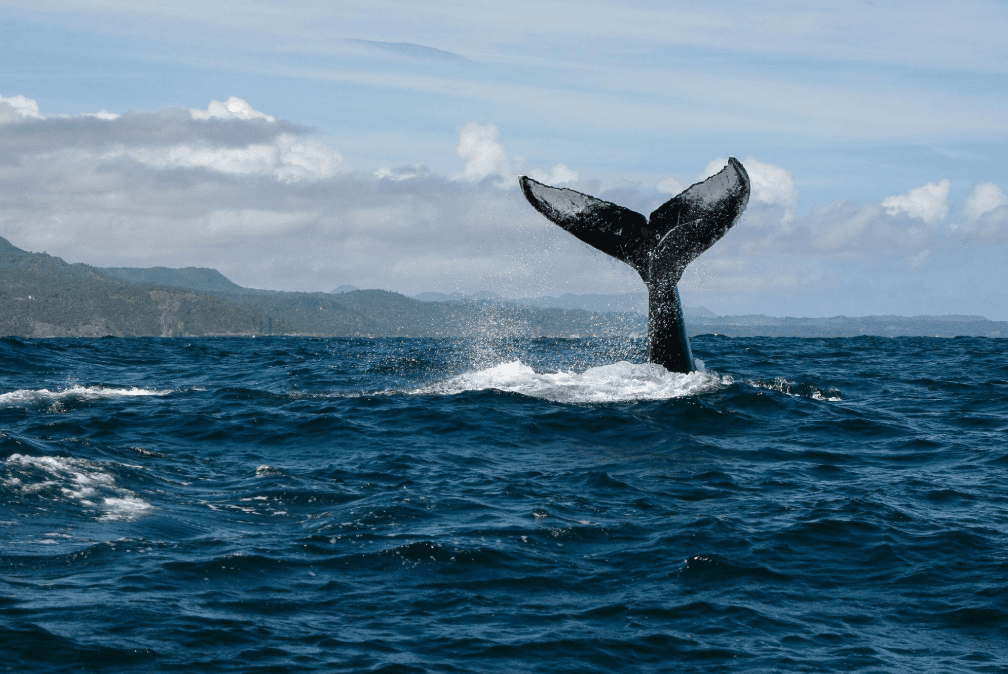
Humpback whales have distinctive tail-fluke patterns. Researchers photograph these patterns and compare pigmentation, markings, scars, and other visible features to identify individuals.
When photographs provide a sufficiently reliable match, researchers can link observations from different dates to the same whale.
This creates a record of when that individual was observed in the study area.
For example, imagine that a whale is photographed on February 5, photographed again on February 12, and recorded once more on February 21. These observations establish that the individual was documented on three separate dates.
They do not prove that it remained continuously inside the bay for the entire period.
The whale might have left the surveyed area and returned, or it might have remained nearby without being detected during the days between sightings.
Photo-identification is therefore an essential starting point, but researchers must interpret the resulting timeline carefully.
2. Calculating the Interval Between First and Last Sightings
One straightforward measurement is the interval between the first and last confirmed sightings of an identified whale.
Consider this hypothetical example:
- First recorded sighting: February 5.
- Second recorded sighting: February 12.
- Last recorded sighting: February 21.
The elapsed time between the first and last sightings is 16 days.
This tells researchers that the whale was documented at both ends of a 16-day interval. It does not establish that the whale stayed continuously within the bay for all 16 days.
This distinction is particularly important when observations are infrequent.
If a whale is photographed on February 5 and not seen again until February 21, researchers have less information about its movements during the intervening period than they would if it were observed every day.
The first-to-last-sighting interval is useful as a descriptive measurement, but it should not automatically be reported as confirmed continuous residence.
3. Recording the Gaps Between Sightings
The time between sightings can provide useful information about how frequently an individual is detected.
Researchers may examine whether a whale is recorded on consecutive days, after several days, or following a much longer gap.
These intervals can help scientists investigate patterns of repeated area use.
However, a gap does not reveal exactly what the whale was doing.
A whale that disappears from the records may have:
- Remained within the area but gone undetected.
- Moved into a section of the bay that was not surveyed.
- Left the defined study area temporarily.
- Departed from the region for a longer period.
- Returned after spending time elsewhere.
Scientists therefore consider the observation schedule and the spatial coverage of each survey before interpreting gaps.
Long gaps generally leave greater uncertainty about the animal's location and the continuity of its presence.
4. Measuring Survey Effort and Detection Probability
Scientists cannot reliably estimate residence time from sightings alone without considering how the observations were collected.
If researchers survey the bay every day, they have more opportunities to detect whales than if they visit only once a week. Yet even frequent surveys do not guarantee that every whale present will be observed.
Detection can depend on sea conditions, visibility, whale behavior, survey routes, and the time spent searching.
To address this problem, researchers record survey effort and may use statistical models that account for imperfect detection.
For example, they may compare periods when whales were detected with periods when surveys were conducted but no whales were observed.
A no-sighting day is more informative when researchers know that an adequate survey was completed under suitable conditions. Even then, it does not prove that no whales were present.
Models can help estimate the likelihood that an animal remained in the area despite being missed, provided the study design and data support the assumptions required.
5. Distinguishing Temporary Absence From Permanent Departure
A particularly difficult problem is determining whether a whale has temporarily moved away or has permanently left the study area for the period being investigated.
Suppose an identified whale is recorded early in the season, is not detected for several days, and then appears again.
The later observation demonstrates that the whale returned to the area or remained within the broader survey region during the interval. It does not reveal exactly where the whale traveled while it was not being observed.
Researchers may use several approaches to investigate these patterns.
Repeated photo-identification: Confirms whether later sightings involve the same individual.
Broader geographic coverage: Helps establish whether whales are being observed in nearby areas.
Movement tracking: Where appropriate, tracking data can provide more continuous location information.
Statistical models: Some methods can estimate residence or temporary emigration while accounting for imperfect detection.
The distinction matters because temporary absence should not automatically be treated as final departure.
6. Comparing Residence Time Between Individual Whales
Not every humpback whale necessarily uses Samaná Bay in the same way.
Some individuals may be photographed repeatedly over an extended period, while others may be recorded only once or twice. These differences could reflect actual movement patterns, differences in behavior, or differences in the likelihood of detection.
Scientists can compare individuals when sufficient data are available.
Possible comparisons include:
- The number of days between first and last sightings.
- The number of separate encounters recorded.
- The frequency of repeated observations.
- The distribution of sighting intervals.
- The estimated likelihood of continued presence.
- Differences among identifiable behavioral or social groups, where the data support such comparisons.
Researchers should not automatically conclude that an individual seen frequently has a longer residence time. It might simply spend more time in areas where researchers operate.
Meaningful comparisons require consideration of survey effort, detection probability, and the quality of individual identification.
7. Investigating Residence Time Across Different Parts of the Season
Residence patterns may differ between stages of the breeding season, but researchers need comparable data to investigate such differences.
They can divide observations into defined periods and examine how frequently individual whales are encountered within each period.
For example, scientists might compare the intervals between sightings during early-season and late-season surveys. They could also examine whether identified whales continue to be recorded as the season progresses.
However, seasonal differences in sightings do not automatically indicate differences in residence time. The mix of individuals present may change, and survey coverage may not be identical throughout the season.
Researchers should distinguish between a change in the number of sightings, a change in the number of individuals, and a change in estimated residence time.
These are separate measurements and may have different explanations.
8. Statistical Methods for Estimating Residence Time
The most appropriate statistical method depends on how frequently whales are observed and whether researchers can identify individuals reliably.
Several approaches may be useful.
Mark-recapture models
In photo-identification studies, individual whales can serve as recognizable animals that are repeatedly detected during surveys.
Mark-recapture models use these repeated detections to estimate population and movement-related parameters, depending on the model design.
Some models can account for differences in detection and temporary emigration. However, not every mark-recapture model estimates individual residence time directly.
Encounter-history analysis
Researchers can represent an individual's observations as a sequence of detection and non-detection occasions.
For example, a record might indicate that a whale was detected during the first and third surveys but not during the second.
Across many individuals, these histories can help scientists investigate patterns of persistence, return, and detectability.
Time-to-event methods
When the research question concerns the time until an observed event, such as a last detection or estimated departure, suitable time-to-event methods may be useful.
These methods require careful handling of uncertainty. The last sighting is not always the same as the actual departure, and the appropriate model depends on the sampling design.
Uncertainty intervals
Researchers should communicate how precise an estimate is rather than presenting every residence-time estimate as an exact number.
If observations are sparse, the uncertainty may be substantial. More frequent and reliable observations can improve the information available, although they do not eliminate every source of uncertainty.
9. Why Residence Time Matters for Conservation
Understanding how long whales use a marine area can help researchers assess its importance as seasonal habitat.
Repeated records may indicate that some individuals use the region over extended periods, while others are documented during shorter intervals.
Such findings can help scientists design future surveys, investigate habitat use, and evaluate possible interactions with marine activities.
Residence-time information may also help conservation planners consider whether management measures should account for repeated whale presence throughout a season rather than focusing only on peak sighting periods.
However, estimates must be interpreted within their geographic and scientific limits. An individual that is not detected in one bay may still be using nearby waters.
Conservation decisions are strongest when residence estimates are considered alongside other evidence, including movement patterns, habitat characteristics, whale behavior, and human activity.
10. What Residence-Time Estimates Mean for Whale Watchers
For visitors, repeated whale sightings may create the impression that particular animals remain in one location for long periods.
In reality, whales move through a changing marine environment, and their presence on a particular day cannot be guaranteed.
Scientific residence-time estimates describe patterns across observations; they are not a promise that a whale will remain available for viewing.
Travelers planning a whale-watching trip should check the current seasonal guidance from reputable local operators and follow responsible viewing practices.
Boats should observe applicable regulations and maintain appropriate distances. Wildlife should never be pursued simply to relocate an individual that has not been seen recently.
Frequently Asked Questions
How do scientists estimate how long humpback whales stay in Samaná Bay?
They combine repeated sightings, photo-identification, survey records, and, where suitable, statistical models that account for missed detections and movement outside the study area.
Does the time between the first and last sighting equal residence time?
Not necessarily. It is the observed interval. The whale may have left and returned, or it may have remained present while being undetected between encounters.
Can a whale leave Samaná Bay and return later?
Repeated observations of the same identified whale can demonstrate that it was recorded at separate times. Establishing whether it left the bay between encounters requires additional evidence.
Why is photo-identification important?
It helps researchers recognize individual whales across multiple encounters. Without reliable identification, repeated sightings cannot always be assigned to the same animal.
Can scientists calculate an exact residence time for every whale?
No. The available records may be incomplete, and detection gaps make exact residence difficult to determine. Some studies can estimate residence patterns more reliably than others.
Why does residence time matter for whale conservation?
It helps researchers investigate how whales use breeding habitat, design monitoring programs, and assess potential interactions with human activities. The findings can support conservation planning when interpreted alongside other evidence.
Conclusion
Estimating how long humpback whales stay in Samaná Bay requires more than calculating the number of days between two photographs. Scientists must identify individual whales, document observation effort, interpret gaps between encounters, and choose methods appropriate to the data.
The strongest estimates distinguish confirmed sightings from inferred periods of presence and communicate uncertainty clearly.
By improving these methods, researchers can develop a better understanding of humpback whale habitat use and support responsible management of the marine environment around Samaná Bay.

Local explorer & expert guide in Visita Haitises.