Why Do Humpback Whales Breach The Science Behind Whale Leaping
Few wildlife experiences are as unforgettable as watching a humpback whale launch its enormous body out of the ocean before crashing back into the water. This spectacular behavior, known as breaching, is one of the most recognizable displays associated with humpback whales.
For visitors on a whale-watching trip in Samaná Bay, Dominican Republic, a breach can become the highlight of the entire experience. But why do humpback whales leap out of the water Are they playing, communicating, removing parasites, or displaying strength?
Scientists have identified several possible explanations, but there is no single reason that explains every breach. A whale may breach for different reasons depending on its circumstances, and researchers cannot always determine its motivation from a surface observation.
In this guide, we explore seven possible explanations for humpback whale breaching, how scientists study this behavior, and what it means for responsible whale watching in Samaná.
What Is Breaching in Humpback Whales?
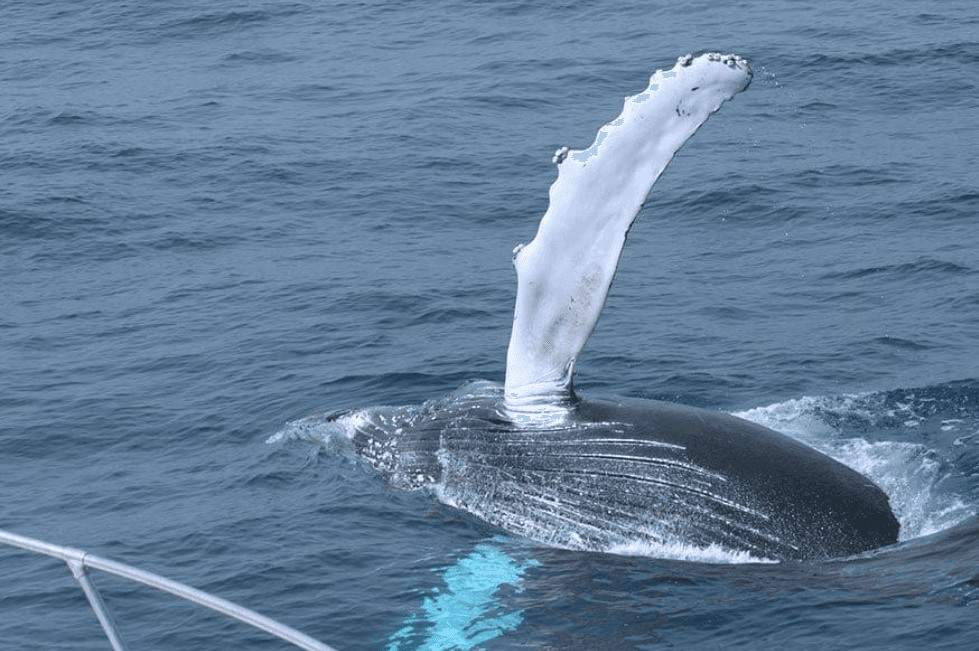
Breaching occurs when a whale propels a substantial portion of its body out of the water before falling back into the sea. Some breaches involve much of the whale's body emerging above the surface, while others are smaller or less complete.
A humpback whale may approach the surface, accelerate, and use powerful movements of its tail and body to rise into the air. The resulting splash can be enormous because an adult humpback is a large, heavy animal.
Breaching is different from simply surfacing to breathe. It is also different from raising the tail flukes, slapping the water with a fin, or rolling at the surface.
Researchers observe breaching in different populations and contexts, including breeding areas and feeding grounds. The behavior is energetically demanding, but whales sometimes repeat it several times in succession.
1. Breaching May Help Humpback Whales Communicate
One possible explanation is that breaching serves as a signal to other whales.
A breach creates a large splash and a substantial underwater sound. These effects may be detectable by other whales nearby, potentially providing information about an animal's location or activity.
Humpbacks live in an environment where sound can travel over considerable distances underwater. Physical displays may therefore complement other forms of communication.
However, scientists cannot assume that every breach is a deliberate message. A breach may have multiple effects, and the precise meaning of the behavior can be difficult to establish.
Researchers examine the circumstances surrounding a breach, including the presence of other whales and the behavior that follows, to investigate its possible social function.
2. Breaching May Be Associated With Courtship and Competition
Humpback whales gather in warm breeding areas during the appropriate season. In these regions, researchers sometimes observe energetic social interactions, including chasing, physical contact, and surface displays.
Breaching may occur during these interactions. A large display could potentially influence other whales or form part of a broader social encounter.
Nevertheless, a breach alone does not prove that a whale is courting a potential mate or competing with another animal.
The context matters. Scientists look at the number of whales present, how they move relative to one another, and whether other behaviors occur before or after the breach.
For visitors in Samaná Bay, observing a breach during the breeding season is exciting, but its exact reproductive meaning usually cannot be determined from the splash alone.
3. Breaching Could Help Whales Respond to Irritation
Some researchers have proposed that vigorous surface behaviors may help whales respond to irritating organisms or other sensations on their bodies.
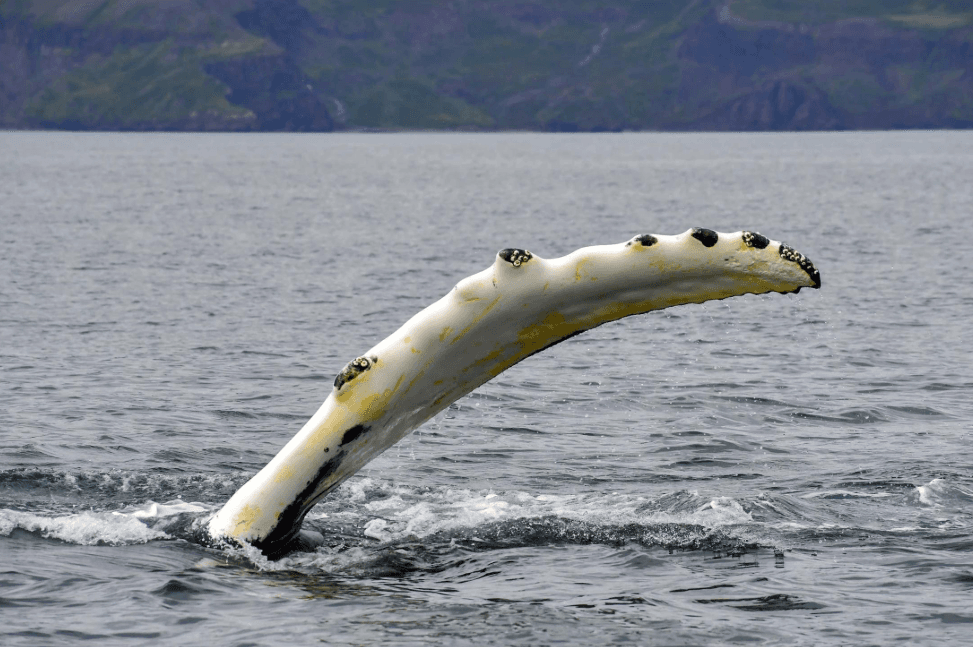
Humpback whales can carry barnacles and whale lice, among other marine organisms. These associations are part of their natural ecology, although their effects vary.
A powerful movement could potentially alter contact between the whale's body and surrounding water. However, it would be misleading to claim that breaching is primarily a way to remove parasites.
There is no universal explanation for breaching based on skin irritation, and observing a breach does not establish that the animal is uncomfortable.
This is one example of why scientists distinguish plausible hypotheses from explanations supported by strong evidence.
4. Breaching May Be Related to Play or Exploration
Young humpback whales sometimes display energetic movements and repeated surface activity. Researchers and observers have suggested that some behaviors may be associated with play, exploration, or the development of physical skills.
Breaching can look playful to human observers, particularly when a whale repeats the movement or combines it with rolling and splashing.
However, appearance alone does not prove an animal's emotional state. Scientists must be cautious about assigning human feelings or intentions to wildlife.
A young whale's repeated breaches may have several possible explanations, and the same behavior can occur in adults.
The most accurate conclusion is that play or exploration may contribute to some surface activity, but not every breach should be interpreted this way.
5. Breaching May Help Whales React to Their Surroundings
Humpback whales live in changing environments. They encounter other whales, vessels, shifting ocean conditions, and a variety of natural stimuli.
Some surface displays may occur during heightened activity or in response to nearby events. Breaching could be associated with arousal, agitation, or a change in social circumstances.
Yet researchers cannot reliably identify a whale's emotional state from a breach alone. The animal may be responding to several influences at once, or the behavior may occur without an obvious external trigger.
For whale watchers, the important point is to observe rather than assume. If a whale breaches, it is best to appreciate the display without treating it as proof that the animal is happy, angry, frightened, or asking a boat to approach.
6. Breaching May Produce Signals That Travel Through Water
A breach is not just a visual event. The whale's body striking the surface generates sound and pressure waves that move through the surrounding water.
These acoustic effects could play a role in interactions between whales, although their exact significance is not fully understood.
Researchers can use underwater microphones called hydrophones to record sounds and compare them with visible behavior. Such studies help investigate whether particular displays tend to occur in specific social contexts.
It is important not to confuse the sound created by a breach with the complex vocalizations humpback whales produce. A splash is a physical consequence of the whale hitting the water, while vocal sounds arise through different biological processes.
The two may occur in the same general environment, but they should not automatically be assumed to serve the same function.
7. Some Breaches May Have More Than One Purpose
Animal behavior does not always have a single explanation. A breach could have several effects, and its function may differ between encounters.
For example, a breach may produce a visible display, create an underwater sound, and occur during a social interaction. Researchers may be unable to determine which effect matters most to the whale.
Some breaches may also occur for reasons that scientists have not yet established.
This uncertainty is a normal part of wildlife research. Observations provide evidence, but explaining motivation requires more than recording what an animal does.
Rather than treating one hypothesis as the answer, scientists compare observations from different populations, seasons, and environmental conditions.
How Do Humpback Whales Breach?
Although the exact mechanics can vary, breaching requires a whale to generate enough upward movement to bring a large portion of its body above the surface.
The whale uses powerful muscles and movements of its body and tail. The timing, angle, speed, and depth of approach can influence how much of the body emerges.
Not every breach looks identical. Some whales rise steeply, while others emerge at an angle. A whale may rotate or twist during the movement, and the splash can obscure much of the body as it falls back into the water.
The effort involved can be substantial. Repeated breaching may therefore reflect a period of energetic activity rather than an effortless movement.
Even so, scientists should not infer the reason for a breach simply from its height, angle, or apparent force.
Do Humpback Whales Breach More During Breeding Season?
Humpback whales are well known for their seasonal gatherings in breeding areas, including the waters around the Dominican Republic.
Breaching is observed in breeding regions, but it is also documented in other contexts. Its occurrence is not limited to courtship, and the presence of a breach does not necessarily indicate mating activity.
The frequency of breaching can vary between locations, populations, individuals, and observation periods. Weather, sea conditions, group composition, and the methods used to record behavior can also influence what observers report.
For this reason, it is difficult to provide a universal rule about when humpbacks breach most often.
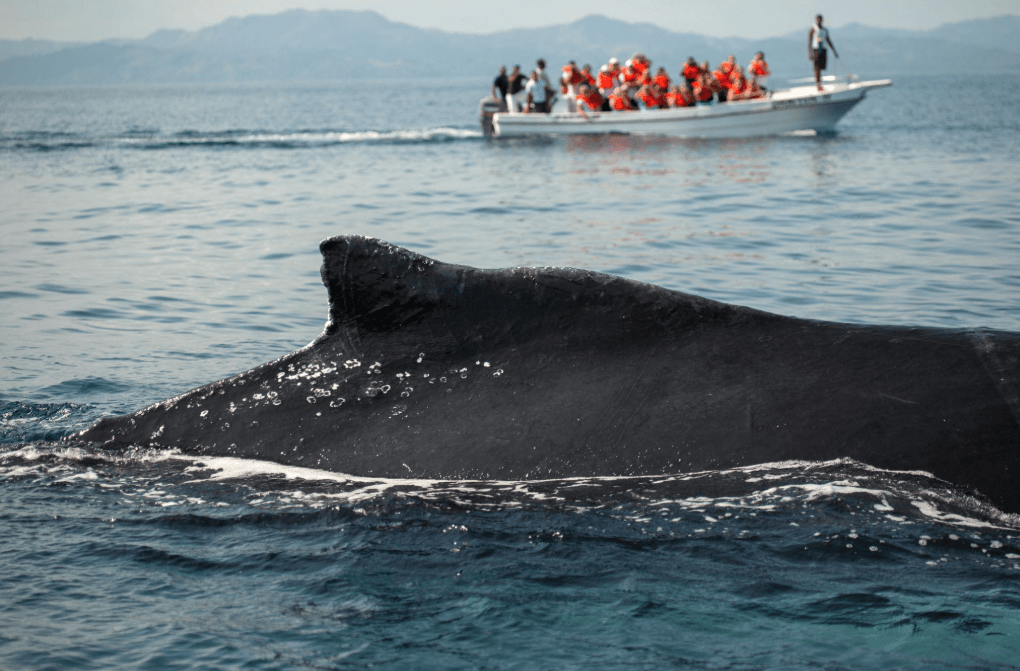
In Samaná Bay, visitors may witness breaching during the seasonal gathering of North Atlantic humpback whales, but no operator can guarantee that a whale will perform this behavior on a particular trip.
Can You See Humpback Whales Breaching in Samaná Bay?
Yes. Breaching is among the possible behaviors visitors may observe during the whale-watching season in Samaná Bay.
The bay is known as a seasonal destination for North Atlantic humpback whales, which visit Caribbean waters during the Northern Hemisphere winter breeding period.
During an excursion, visitors may see whales surfacing, raising their tails, traveling in groups, or occasionally launching themselves out of the water.
However, whale behavior is unpredictable. A trip may offer excellent sightings without a single breach, while another encounter may include several dramatic leaps.
For the best experience:
- Choose a responsible whale-watching operator that follows applicable local rules.
- Listen to the crew's instructions and remain safely seated when required.
- Bring a camera or binoculars if you want to observe distant behavior.
- Avoid expecting a specific display from a wild animal.
- Give whales space and never encourage a boat to chase or disturb them.
Breaching can happen quickly, so it helps to keep watching the surrounding water rather than focusing entirely on a camera screen.
Is Breaching Dangerous for Humpback Whales?
Breaching is a naturally occurring behavior, and humpback whales are physically capable of performing it. However, the movement requires considerable force and energy.
Scientists cannot assume that every breach has the same energetic cost or purpose. Factors such as body size, movement, and the number of repeated breaches may affect the demands involved.
The behavior itself should not automatically be treated as evidence of injury or distress.
At the same time, whales face risks from human activities, including vessel strikes, fishing-gear entanglement, and disturbance. Responsible wildlife observation helps reduce avoidable interference.
If a whale is breaching near a boat, the crew should follow the applicable approach and distance rules rather than move closer to obtain a better photograph.
How Do Scientists Study Whale Breaching?
Researchers investigate breaching by recording the behavior and examining the circumstances in which it occurs.
Behavioral observations
Scientists note how often whales breach, whether the behavior is repeated, and what other animals are nearby. These records help identify patterns across different contexts.
Photo and video analysis
Images and video can help researchers document body position, movement, and the sequence of events around a breach. They may also help identify individual whales when distinctive markings are visible.
Acoustic research
Hydrophones can record sounds associated with whale activity, including the noise generated when a whale strikes the surface. Comparing acoustic recordings with visual observations can help researchers investigate possible communication functions.
Long-term studies
Observations collected across multiple seasons and locations help scientists distinguish recurring patterns from isolated events. Long-term research is particularly important because a behavior seen once may not reveal its usual function.
Even with these methods, the motivation behind an individual breach may remain uncertain.
Frequently Asked Questions
Why do humpback whales jump out of the water?
Breaching may be associated with communication, social interactions, courtship, play, or responses to environmental stimuli. Scientists have not established one explanation that accounts for every breach.
Do humpback whales breach to communicate?
Breaching produces visual and acoustic signals that could contribute to communication. However, its precise role depends on context and is not fully understood.
Do humpback whales breach to remove parasites?
This has been suggested as a possible explanation for some vigorous surface behaviors, but it is not established as the main reason humpbacks breach.
Are humpback whales breaching when they are happy?
A breach does not reliably reveal a whale's emotional state. It is better to describe the behavior without assuming that it represents happiness or another specific feeling.
Can I see a humpback whale breach in Samaná Bay?
It is possible during the whale-watching season, but breaching is unpredictable. No trip can guarantee this particular behavior.
What is the difference between breaching and tail slapping?
Breaching involves a whale propelling a substantial portion of its body out of the water. Tail slapping involves striking the water with the tail flukes. Both create splashes, but they are distinct behaviors.
Final Thoughts
Humpback whale breaching is a spectacular display, but its purpose is more complicated than it may first appear. Communication, social interactions, courtship, play, and reactions to the environment are among the possibilities scientists investigate.
The same movement may have different meanings in different circumstances, and some breaches remain unexplained. That uncertainty makes continued research important.
If you visit Samaná Bay during whale-watching season, a breach may become an unforgettable highlight. Enjoy the moment, observe responsibly, and remember that giving whales space allows them to continue their natural behavior without unnecessary disturbance.

Local explorer & expert guide in Visita Haitises.