How Do Humpback Whales Mate Understanding Their Breeding Behavior
Humpback whales travel thousands of miles between feeding grounds and warmer tropical waters where they breed and give birth. Every year, these remarkable marine mammals gather in breeding regions, including Samaná Bay in the Dominican Republic. Their seasonal visits give researchers an opportunity to study their social interactions and reproductive behavior.
But how do humpback whales mate Scientists know that mating takes place in the water, but observing the complete process is difficult because whales spend much of their time underwater. Researchers have learned about their breeding behavior through surface observations, photography, tagging, and long-term studies.
This guide explains what is known about humpback whale mating, how courtship behavior works, and what visitors may observe during whale-watching season in Samaná.
When Do Humpback Whales Mate?
Humpback whales generally mate during their breeding season in warmer waters. North Atlantic humpbacks migrate to Caribbean breeding areas during the Northern Hemisphere winter, including waters around the Dominican Republic.
Samaná Bay is an important seasonal habitat where humpbacks gather during this period. The broader Caribbean breeding grounds provide opportunities for adults to find potential mates and for pregnant females to give birth.
The timing is not identical for every whale. Individual animals may arrive and leave at different times depending on their condition, reproductive status, and migration patterns.
Humpbacks typically feed intensively in colder waters during other parts of the year. During the breeding season, they may spend extended periods in tropical or subtropical waters, where feeding is often less central to their activities.
How Do Humpback Whales Find Mates?
Humpback whales do not form permanent breeding pairs. Their mating system is generally described as polygynous or promiscuous in practice, with males competing for access to females and mating associations that may change over time.
Researchers study several kinds of behavior that may be associated with reproduction.
Social interactions
Humpbacks may travel alone or in temporary groups. During the breeding season, individuals sometimes approach one another, follow each other, or form groups that change as the whales move.
These interactions can be difficult to interpret from the surface. A group of whales is not necessarily a mating group, and close proximity does not prove that mating is taking place.
Competitive groups
One of the best-known behaviors observed in breeding areas is the formation of competitive groups. Multiple whales, often including males, may follow a female and interact intensely as they move through the water.
These groups can involve rapid swimming, physical contact, splashing, and changes in position. Competition may help determine which males remain close to a female, although the behavior can be complex and is not always easy to interpret.
Vocal and physical signals
Humpbacks produce sounds and display a variety of body movements. Such signals can play roles in social interactions, but scientists cannot assign a single meaning to every sound or movement.
It is important to distinguish general communication from confirmed mating behavior. A whale making sounds or displaying at the surface is not necessarily attempting to attract a mate.
What Happens During Humpback Whale Mating?
Humpback whales mate in the water. Like other mammals, fertilization occurs internally. However, direct observations of the complete mating process are relatively limited, and many details are difficult to study in the open ocean.
The animals' large bodies, underwater movements, and the challenges of observing them without disturbance make detailed research difficult.
Scientists therefore combine occasional direct observations with other evidence, including reproductive anatomy, pregnancy records, genetic studies, and long-term observations of known individuals.
These methods help researchers understand reproductive patterns without assuming that every social encounter leads to mating.
Do Humpback Whales Have One Mate for Life?
No. Humpback whales are not generally considered to form lifelong mating pairs.
Individuals may mate with different partners across breeding seasons. A female and male seen together on one occasion may not remain together afterward, and researchers cannot determine a lasting relationship from a single sighting.
This differs from species that form long-term pair bonds. Humpback whale social relationships are often temporary and influenced by seasonal conditions, reproductive status, and individual behavior.
Researchers use photographs of distinctive tail flukes and other identification methods to track individuals over multiple years. These records help scientists investigate where whales travel and how their reproductive histories may develop.
How Long Is a Humpback Whale's Pregnancy?
A humpback whale's pregnancy lasts approximately 11 months, although the precise timing can vary.
Females usually give birth to a single calf. The calf is born in the water and must quickly reach the surface to breathe. Its mother provides milk and remains important to its early development.
Because gestation lasts close to a year, mating and calving are connected to the whales' seasonal migration cycle. Females that become pregnant must support fetal development before giving birth, often during a subsequent breeding season.
Not every female becomes pregnant during every breeding season. Reproductive outcomes depend on individual condition, age, health, and other factors.
Why Do Humpback Whales Breed in Warm Waters?
Warm breeding areas provide conditions that are generally favorable for newborn calves. Young calves have less body insulation than adults and benefit from the thermal environment of tropical and subtropical waters.
Breeding areas can also provide relatively sheltered habitats, depending on local geography and conditions. However, not every breeding area is equally protected, and the degree of shelter varies.
Humpbacks do not choose warm waters because they cannot survive cold environments. Adults are adapted to colder feeding grounds, where blubber helps insulate their bodies. Their seasonal movements allow them to use different habitats for feeding and reproduction.
Samaná Bay is one example of a Caribbean region where visitors can encounter humpbacks during their winter breeding season.
Can You Observe Mating Behavior in Samaná Bay?
Visitors sometimes witness energetic whale interactions during the Samaná whale-watching season. Whales may swim close together, surface repeatedly, slap the water, or move in groups.
Some of these behaviors may be associated with competition or courtship, but they can have other explanations. It is not possible to identify mating with certainty from every surface display.
During a whale-watching trip, you may see:
- Two or more whales traveling together.
- Competitive groups involving several whales.
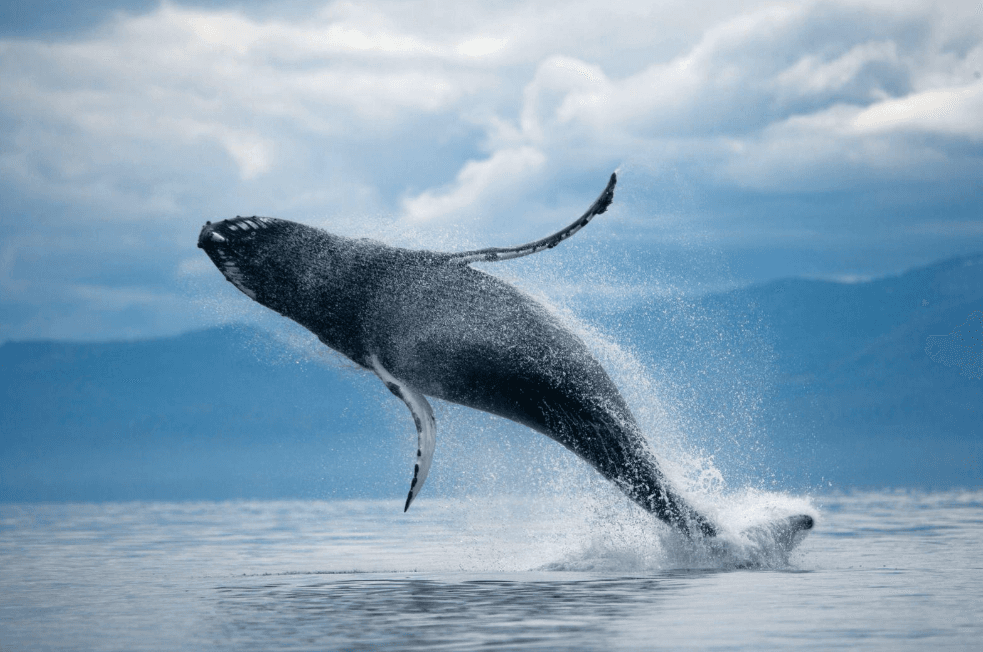
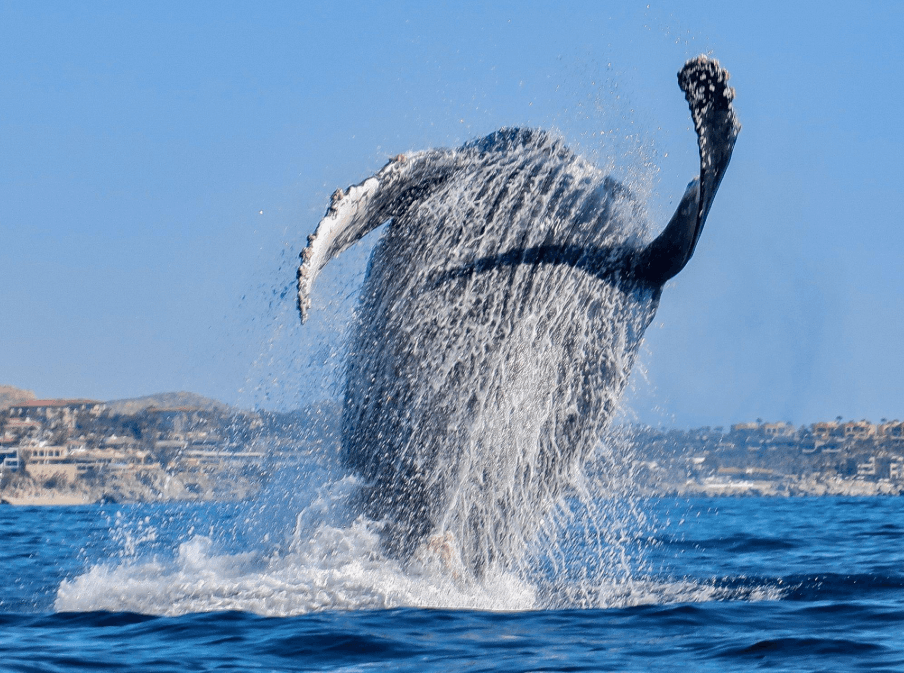
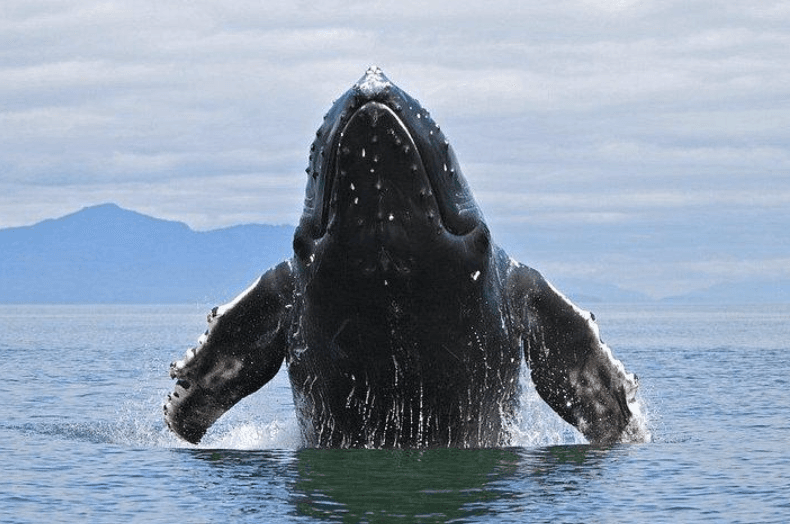
- Surface displays such as splashing or breaching.
- Whales changing direction or swimming rapidly.
- Mothers traveling with calves.
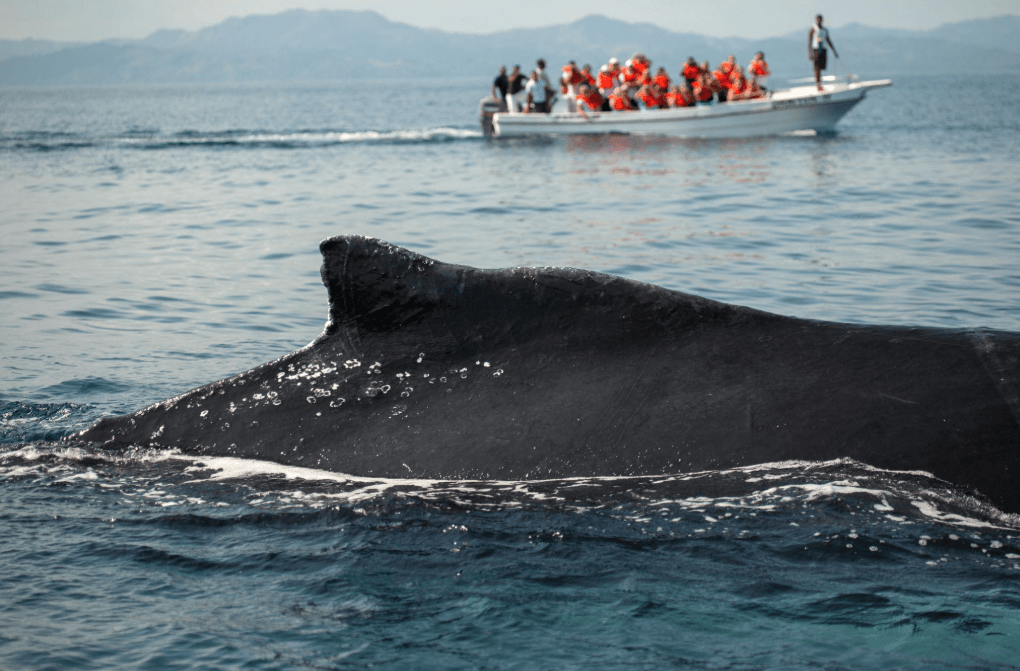
These observations can be fascinating, but responsible interpretation matters. A guide should avoid promising that visitors will witness mating, courtship, or any particular behavior on a specific trip.
Whales must also be given adequate space. Boats should follow applicable local rules and avoid interfering with interactions, especially when animals are moving rapidly or traveling in groups.
How Do Scientists Study Humpback Whale Reproduction?
Studying reproduction in wild whales requires patience and multiple research methods.
Photo identification
Researchers photograph distinctive markings on the underside of tail flukes. Comparing photographs over time can help identify individual whales and establish records of repeated sightings.
Behavioral observations
Researchers document group composition, movements, surface displays, and interactions. Repeated observations can reveal seasonal patterns and help scientists develop hypotheses about social behavior.
Genetic research
Genetic samples collected through approved scientific methods can help investigate relatedness and reproductive patterns. Such research can provide evidence that visual observations alone cannot establish.
Long-term monitoring
Records gathered over many years help researchers investigate how often individual whales return to particular regions, how populations change, and how reproductive success may vary.
Each method has limitations. For example, seeing a female with a calf provides evidence of a successful birth, but it does not necessarily reveal which male fathered the calf.
Are Humpback Whales Endangered Because of Their Mating Behavior?
Humpback whales have been heavily affected by commercial whaling in the past. Many populations have recovered substantially since protections were introduced, although population status and remaining threats vary by region.
Their reproductive success can be affected by more than mating behavior. Entanglement in fishing gear, ship strikes, underwater noise, habitat changes, and changing prey availability may affect individual whales and populations.
Because humpbacks reproduce relatively slowly compared with many smaller animals, population recovery can take time after severe declines.
Protecting breeding habitats and reducing human disturbance are important parts of conservation. Responsible whale watching can help visitors appreciate whales while supporting a culture of observation that respects their natural behavior.
Frequently Asked Questions
Do humpback whales mate underwater?
Yes. Humpback whales mate in the water, and fertilization is internal. The full process is difficult to observe in the wild.
What month do humpback whales mate in Samaná?
Humpbacks visit the waters around Samaná during the Northern Hemisphere winter breeding season. Mating can occur during this seasonal period, but researchers cannot identify a single month that applies to every whale.
Do humpback whales mate with the same partner every year?
They are not generally known for lifelong mating pairs. Individuals can have different partners across breeding seasons.
Can tourists see humpback whales mating?
It is possible to witness social interactions that may be associated with courtship or competition, but actual mating is rarely something a visitor can reliably expect to see.
How many calves does a humpback whale have at once?
Humpbacks typically give birth to one calf at a time.
Why do humpback whales travel to the Caribbean?
North Atlantic humpbacks use Caribbean waters as seasonal breeding and calving habitat. Many spend other parts of the year feeding in colder northern waters.
Final Thoughts
Humpback whale mating is part of a remarkable annual cycle that connects their northern feeding grounds with warmer breeding waters in the Caribbean. Although scientists have learned much about their reproductive behavior, the details of individual encounters can remain uncertain because much of the activity happens underwater.
Samaná Bay offers an opportunity to appreciate humpbacks during their seasonal visit, whether they are traveling in groups, displaying at the surface, or swimming with calves. The most rewarding whale-watching experiences combine curiosity with respect for the animals' space and natural behavior.
By learning about humpback whale reproduction and supporting responsible observation, visitors can gain a deeper understanding of these marine mammals and the importance of protecting their ocean habitats.

Local explorer & expert guide in Visita Haitises.