How Do Humpback Whales Sleep Resting Behavior Explained
Imagine watching a humpback whale disappear beneath the surface of Samaná Bay. The water becomes calm, the whale remains out of sight, and you begin to wonder: could this enormous marine mammal be sleeping underwater?
Humpback whales need rest just like other mammals. However, sleeping in the ocean presents a unique challenge. Unlike humans, whales cannot breathe automatically underwater. They must return to the surface to take a breath, even when they are resting.
So, how do humpback whales sleep? They rest in ways that allow them to conserve energy while remaining capable of breathing and responding to their surroundings. Scientists continue to investigate exactly how whale sleep works, but observations of resting whales provide fascinating insights into their behavior.
In this guide, you will learn how humpback whales rest, whether they sleep underwater, how they breathe during sleep, and what their resting behavior means for people interested in whale watching in Samaná Bay, Dominican Republic.
Do Humpback Whales Sleep?
Yes. Humpback whales sleep and rest, although their sleep patterns differ from those of humans.
Humans usually sleep on land, where breathing continues automatically. Humpback whales live in an environment where breathing requires them to reach the surface. Their resting behavior must accommodate this need.
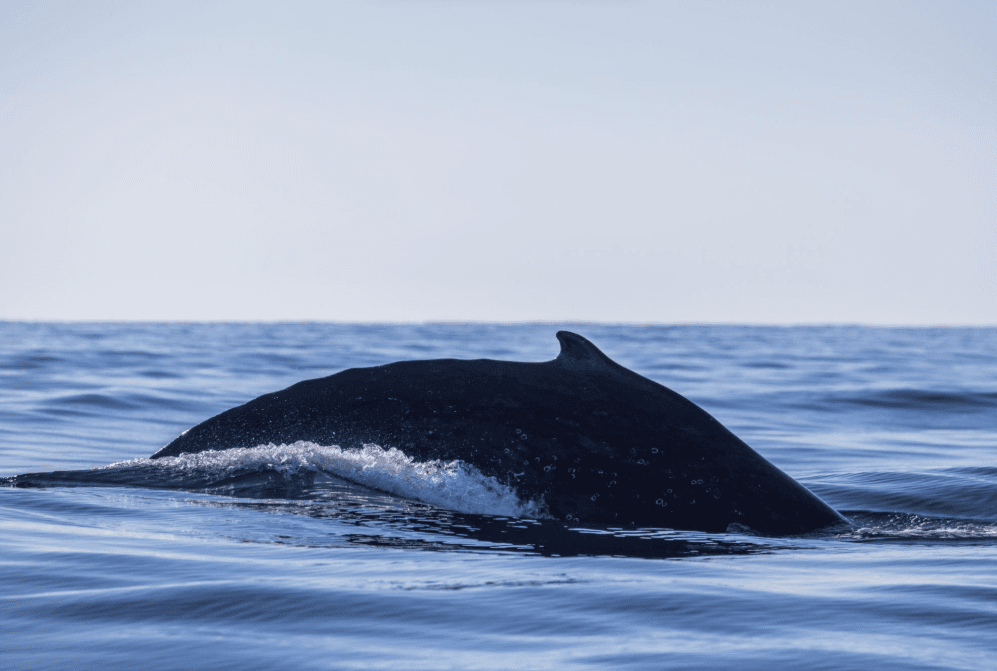
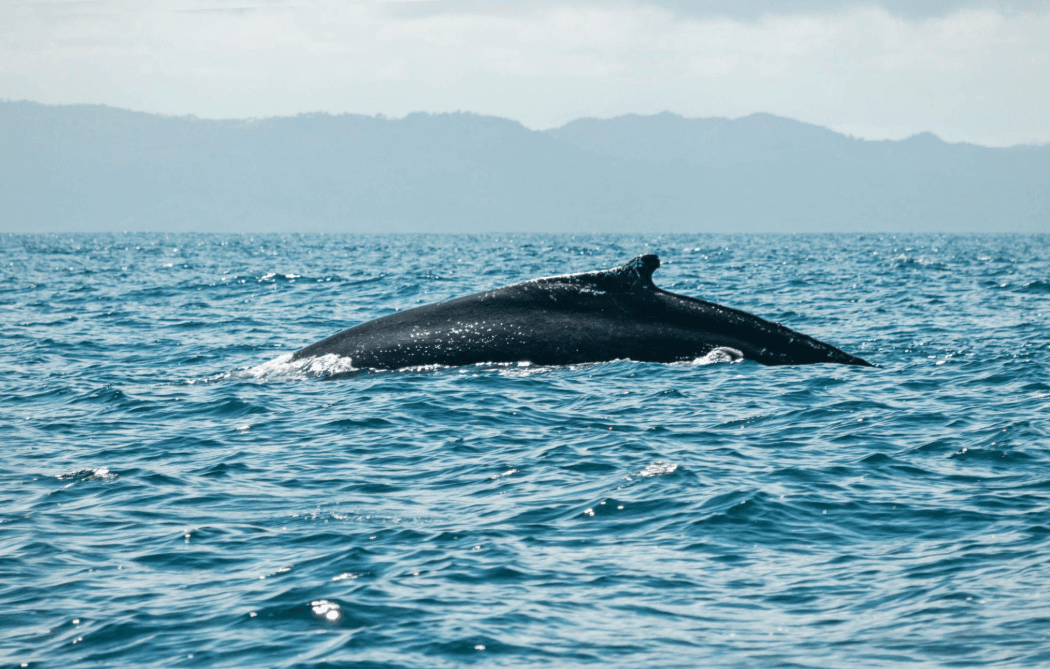
Scientists have observed whales resting quietly in the water, sometimes remaining relatively motionless near the surface or below it. Depending on the circumstances, a resting whale may reduce its movement and activity while remaining able to surface for air.
It is important to distinguish between a whale that is resting and one that is asleep. A whale floating quietly is not necessarily sleeping, and researchers cannot always determine its exact state from a brief observation.
Although researchers have learned much about marine mammal sleep, the precise patterns of sleep in wild humpback whales remain an active subject of scientific investigation.
How Do Humpback Whales Sleep Underwater?
Humpback whales can rest in the water without needing a bed or a dry place to lie down. Their large bodies are supported by the surrounding water, allowing them to remain afloat while reducing movement.
Resting behavior can vary. A whale might remain near the surface, drift slowly, or rest below the surface before returning to breathe.
Unlike a person sleeping in a bedroom, a whale must remain capable of managing its breathing. This is one reason marine mammal sleep is so different from human sleep.
Researchers studying cetaceans—the group that includes whales, dolphins, and porpoises—have found evidence that some species use forms of sleep in which only part of the brain rests at a time. This is known as unihemispheric slow-wave sleep.
However, sleep patterns can differ among cetacean species. Findings from dolphins and other whales should not automatically be treated as proof that humpback whales sleep in exactly the same way.
What scientists can say with confidence is that whales have evolved ways to balance rest with the need to breathe and remain in an aquatic environment.
How Do Humpback Whales Breathe While Sleeping?
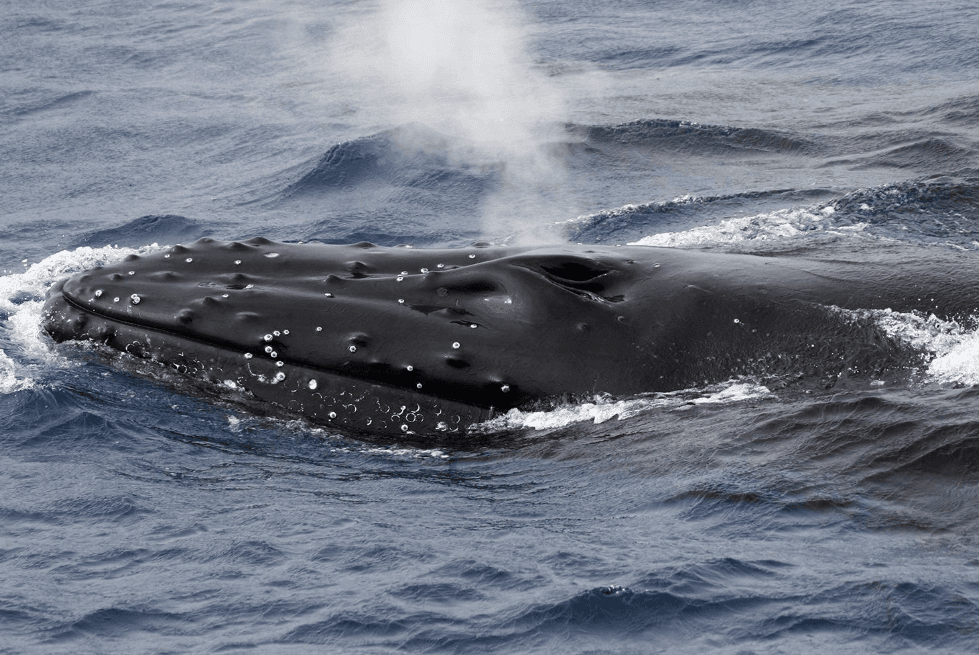
Humpback whales are mammals, so they breathe air through blowholes on top of their heads. They cannot extract oxygen from seawater like fish.
When a humpback whale reaches the surface, it exhales and inhales through its blowholes. It can then dive again.
This breathing system creates a special challenge during rest: the whale must continue to surface when necessary.
Whales do not breathe in exactly the same automatic way humans do. Breathing in cetaceans is under strong voluntary control, which helps them coordinate breathing with swimming and diving. Researchers continue to study how different species manage breathing during periods of rest.
A resting whale may therefore remain near the surface or make movements that allow it to take a breath when needed. The details depend on the animal and its circumstances.
Can a humpback whale drown while sleeping?
Whales can drown if they cannot reach the surface to breathe. Their adaptations for resting in water help them manage this risk, but they do not make whales immune to drowning or other dangers.
This is one reason it is misleading to assume that a whale sleeps exactly like a human. Its body must meet the demands of living underwater while breathing air.
Do Humpback Whales Sleep With Their Eyes Open?
The simple answer is that whale sleep is not identical to human sleep, and eye appearance alone does not reliably reveal whether an individual whale is asleep.
In some cetaceans, differences in brain activity and eye closure help researchers understand resting behavior. However, observations from one species do not necessarily describe every aspect of humpback whale sleep.
A whale seen with an open eye is not necessarily fully awake, just as a whale with its eye closed cannot automatically be assumed to be asleep.
Researchers need more than a quick visual observation to establish what a whale is doing. They may combine behavioral observations with other scientific methods to investigate rest and sleep.
For whale watchers, the best approach is to observe the animal's visible behavior without trying to diagnose its sleep state from its eyes alone.
How Long Do Humpback Whales Sleep?
There is no single, universally established number of hours that can confidently describe the sleep needs of every wild humpback whale.
Sleep is difficult to measure in a free-swimming animal that surfaces to breathe and moves through a changing environment. Scientists must also distinguish periods of inactivity from genuine sleep.
A whale's behavior may vary according to its age, activity, surroundings, and immediate needs. Researchers continue to investigate how wild whales divide their time between swimming, feeding, social behavior, migration, and rest.
Be cautious of claims that humpback whales always sleep for a specific number of hours or follow a rigid daily sleep schedule. Such statements can oversimplify a complex subject.
What is clear is that rest is an important part of mammalian biology, and humpback whales must obtain it while meeting the physical demands of life in the ocean.
Where Do Humpback Whales Rest?
Humpback whales can rest in different parts of their marine habitat. The exact location depends on environmental conditions and the whale's behavior.
They may be observed resting near the surface or spending periods with little visible movement. However, not every quiet whale is resting, and not every resting whale will be easy to see from a boat.
Do humpback whales rest in Samaná Bay?
Samaná Bay, in the Dominican Republic, is well known as a seasonal destination for North Atlantic humpback whales. During the winter breeding season, whales visit the region for activities associated with reproduction and calf rearing.
Because whales use the bay and surrounding waters for different purposes, resting may be part of their broader range of behavior. Nevertheless, a visitor should not expect to see a sleeping whale on a particular trip.
A whale might surface briefly, dive for an extended period, move through the water, or remain outside the viewing area. These behaviors are normal and do not necessarily indicate that the animal is sleeping.
If you are visiting Samaná for whale watching, focus on learning about the whales' natural behavior rather than expecting a specific encounter.
Why Do Whales Need Rest?
Like other mammals, humpback whales expend energy swimming, diving, feeding, and carrying out other essential activities. Rest helps animals recover and maintain normal biological functions.
Rest is particularly interesting in large marine mammals because their lives involve repeated dives and surfacing. They must balance energy use with the need to breathe and remain responsive to their environment.
Several factors may influence a whale's activity and resting behavior:
- Physical activity: Swimming and other movements require energy.
- Environmental conditions: Water conditions and disturbances can influence behavior.
- Life stage: Calves and adults have different physical and behavioral needs.
- Social activity: Interactions with other whales may affect how an animal spends its time.
- Immediate surroundings: A whale's behavior can change when other animals, boats, or environmental changes are present.
These factors do not allow an observer to identify sleep with certainty, but they help explain why whale resting behavior deserves scientific attention.
Can You See a Sleeping Whale on a Samaná Whale-Watching Tour?
It is possible to encounter a whale that appears to be resting, but there is no guarantee that you will witness this behavior during a boat trip.
Whale watching provides opportunities to observe many kinds of natural behavior. Depending on the encounter, visitors might see a whale surface to breathe, show its tail before diving, swim alongside another whale, or display other visible movements.
A quiet whale may be resting, but it could also be moving slowly or simply spending time below the surface. Guides should avoid claiming that an animal is asleep unless the observation supports that conclusion.
If a whale appears inactive, the appropriate response is to give it space. Operators should follow applicable wildlife-viewing rules and avoid pursuing, crowding, touching, feeding, or deliberately disturbing whales.
A responsible whale-watching trip is about observing wildlife on its own terms—not making an animal perform a behavior for visitors.
How to prepare for your trip
If you plan to visit Samaná during whale-watching season, consider these practical tips:
- Confirm the tour's departure point, duration, and inclusions directly with the operator.
- Bring sun protection, water, and any motion-sickness remedies suitable for you.
- Follow the guide's safety instructions throughout the trip.
- Bring binoculars if permitted and useful for observing wildlife from a distance.
- Be patient. Whales spend time underwater, and encounters naturally involve periods when no whale is visible.
The goal is to enjoy the experience while respecting the animals and their habitat.
How Scientists Study Whale Sleep
Studying sleep in wild whales is difficult because researchers cannot simply observe an animal in a controlled bedroom environment. Whales move through large areas of ocean, surface to breathe, and may remain underwater for extended periods.
Scientists can study their behavior through careful observation and specialized research methods. Depending on the species and study, these methods may include monitoring movements, recording behavior, and investigating patterns of brain activity where suitable techniques are available.
Research on dolphins and other cetaceans has helped scientists understand how marine mammals can rest while remaining adapted to aquatic life. Yet important questions remain about how sleep is organized in different whale species.
Humpback whales are large, powerful animals that are not easy to study closely in the wild. Ethical research must also prioritize animal welfare and avoid unnecessary disturbance.
Future research may clarify how humpback whales organize their sleep, how much rest they need, and how their patterns change under different environmental conditions.
Frequently Asked Questions
Do humpback whales sleep at night?
Humpback whales need rest, but their resting patterns should not be assumed to follow the same day-and-night schedule as humans. Their behavior depends on their circumstances, and more research is needed to describe their sleep patterns precisely.
Do humpback whales sleep while swimming?
Whales may rest while in the water, and resting behavior can involve different levels of movement. However, the details of sleep during swimming are not fully established for every whale species. It is best not to assume that humpbacks use exactly the same sleep strategy as dolphins or other cetaceans.
Do baby humpback whales sleep?
Calves need rest as they grow and develop. They also depend on their mothers for milk and protection. The exact sleep patterns of wild humpback whale calves are difficult to observe and should not be reduced to a single universal schedule.
Can boats wake up sleeping whales?
Boats and other human activities can disturb marine mammals, depending on the circumstances. This is why responsible operators follow wildlife-viewing rules and avoid deliberately approaching or disturbing whales. A whale's sleep state may not be obvious to observers.
Are humpback whales active all day?
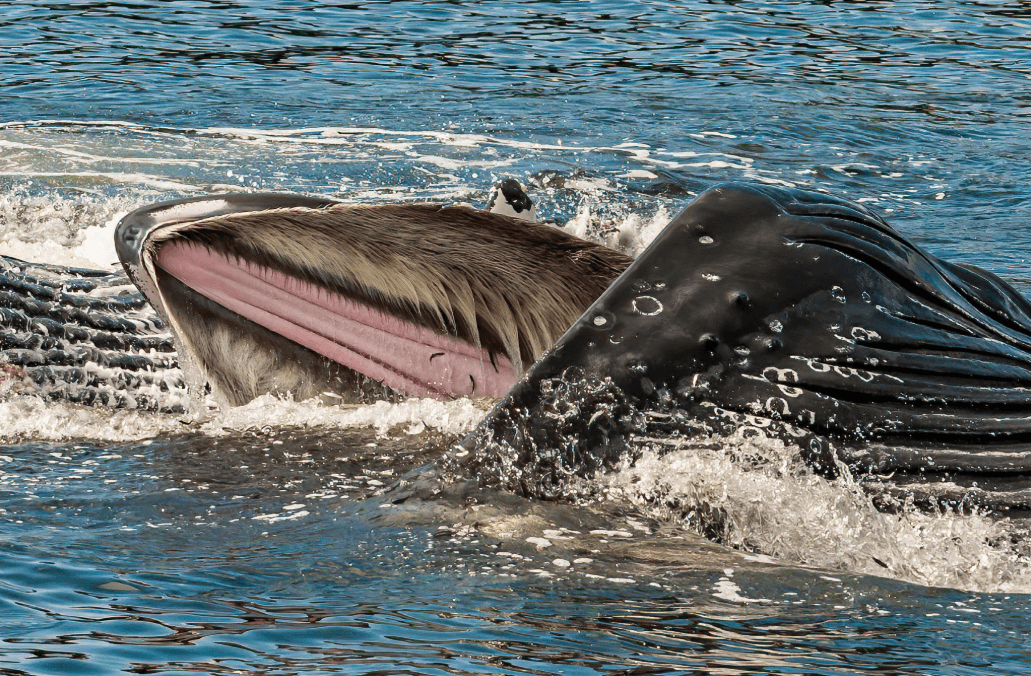
Humpback whales alternate among different activities, which can include swimming, diving, feeding in appropriate habitats, social interactions, and resting. Their activity varies with their environment and life stage.
Is whale watching in Samaná available all year?
Samaná is especially known for seasonal humpback whale watching during the North Atlantic breeding season, generally from January through March, although exact timing and sightings vary. Confirm current local guidance and tour operations before planning your visit.
Final Thoughts: Understanding Humpback Whale Sleep
Humpback whales cannot simply sleep in the same way humans do. They must rest while living in water and maintain the ability to surface for air.
Scientists have developed a better understanding of sleep in marine mammals, but some details of humpback whale sleep remain uncertain. A whale floating quietly is not necessarily asleep, and its exact sleep duration cannot be reliably determined from a brief sighting.
For visitors to Samaná Bay, learning about whale sleep adds another layer of appreciation to the whale-watching experience. Every encounter offers a chance to observe these animals respectfully and understand that their lives continue beyond the moments visible from a boat.
The most rewarding approach is to stay curious, follow responsible wildlife-viewing practices, and let the whales behave naturally.

Local explorer & expert guide in Visita Haitises.