How Do Researchers Estimate How Long Humpback Whales Stay in Samaná Bay?
Every whale-watching season, humpback whales visit the waters around Samaná in the Dominican Republic. Some whales may be observed repeatedly, while others appear only once in the records. This raises an interesting scientific question: how can researchers estimate how long a humpback whale stays in Samaná Bay when they cannot follow it every hour of every day?
The answer involves collecting repeated sightings, identifying individual whales where possible, documenting observation effort, and using statistical methods to account for gaps in the records.
Researchers cannot usually watch every whale continuously from arrival to departure. Instead, they reconstruct a likely timeline from the evidence available. Understanding the difference between a whale's actual stay and the period during which it was observed is essential for interpreting the results correctly.
For visitors interested in Samaná whale watching, this research offers a fascinating perspective on the seasonal presence of humpback whales and the work required to understand their movements.
Why Do Scientists Study How Long Whales Stay?
Estimating how long humpback whales remain in an area can help researchers understand how animals use seasonal habitats.
Samaná Bay is associated with the seasonal presence of North Atlantic humpback whales during their breeding period. Whales may use the wider region for different activities, including social interactions, mating-related behavior, and mother-calf care.
However, not every whale uses the bay in the same way. Individuals may arrive at different times, move between nearby areas, or leave the observation area temporarily before being seen again.
Studying the duration of their presence can help researchers investigate several questions:
- How does the timing of whale sightings change throughout the season?
- Are some individuals documented repeatedly over several weeks?
- Do sightings suggest differences between the seasonal patterns of individual whales?
- How does observation effort influence the estimated length of a whale's stay?
- Can researchers distinguish a temporary absence from a likely departure?
These questions matter because a seasonal count alone cannot describe how individual whales use a habitat over time.
What Does a Whale's "Length of Stay" Actually Mean?
Before estimating duration, researchers need to define what they mean by a whale's stay.
There are several related measurements, and they are not interchangeable.
Observed span: The time between the first and last confirmed sightings of an individual within the study area.
Continuous residence: The period during which the whale remains within a defined area, even if researchers do not see it every day.
Total time present: The combined time an animal spends in the area, which may include separate visits divided by departures.
Seasonal occurrence: The broader period during which a whale population is recorded in a region, regardless of whether the same individuals remain throughout.
The observed span is relatively straightforward to calculate when reliable identification records are available. The actual length of stay is harder to determine because researchers may not know precisely when an individual arrived or departed.
For example, a whale photographed on February 5 and again on February 18 has an observed span of 13 days. That does not prove it remained in Samaná Bay for every one of those days. It may have been present continuously, visited another nearby area, or left and later returned.
This distinction is central to reliable research.
Step 1: Collect Repeated Sightings
The first requirement is a record of whale observations over time.
Researchers may collect sightings through dedicated surveys, vessel-based observations, photographic studies, or other established monitoring methods. Each observation should include a date and, where possible, a location and information about the whale.
The quality of these records affects the conclusions that can be drawn. Consistent observations across the season make it easier to describe changes in whale presence than occasional, irregular sightings.
Researchers also need to document when and where observations were conducted. If surveys take place only on certain days or in particular parts of the bay, whales outside those times and locations may go undetected.
A period without a recorded sighting is therefore not automatically evidence that a whale has left the region.
Step 2: Identify Individual Whales When Possible
To estimate the stay of a particular whale, researchers first need to determine whether sightings on different dates refer to the same animal.
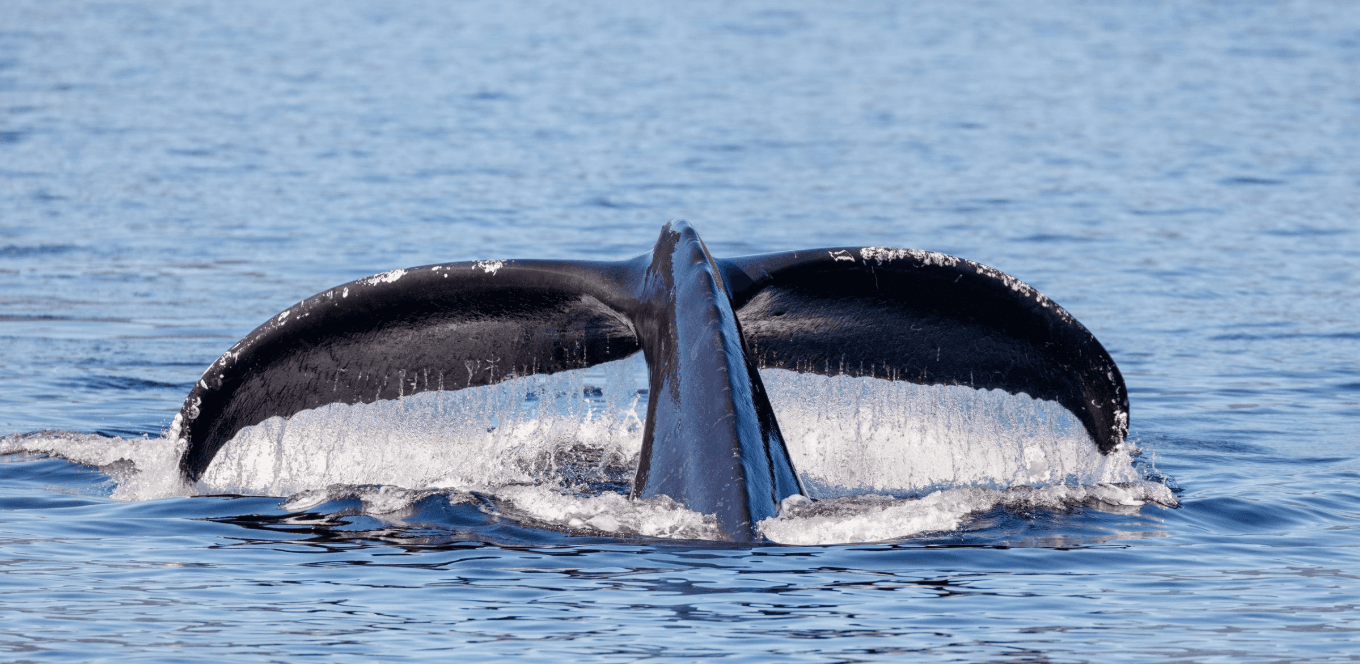
Photo-identification is one method used for this purpose. Scientists compare recognizable characteristics, especially patterns on the underside of a humpback whale's tail fluke, along with other visible features.
When a new photograph matches an existing record with sufficient confidence, the new observation can be added to that individual's sighting history.
Suppose a whale is photographed early in the season, observed again a week later, and recorded once more toward the end of the month. If all three sightings can be reliably matched, researchers can establish the observed span between its first and last records.
If the photographs are unclear or the individual cannot be identified confidently, researchers may still use the observations for broader population-level analyses. They should not, however, assign an uncertain sighting to a particular whale merely to complete its timeline.
Step 3: Record the First and Last Confirmed Sightings
Once researchers have a reliable series of observations, they can calculate the observed span.
Consider a hypothetical example:
- First confirmed sighting: February 6
- Second confirmed sighting: February 12
- Third confirmed sighting: February 21
The time between the first and last sightings is 15 elapsed days.
This is a description of the available records, not proof that the whale spent exactly 15 days continuously in the bay. The actual arrival could have occurred before February 6, and the whale might have remained after February 21.
For this reason, researchers should label the measurement accurately. Calling it an observed sighting span avoids implying that the animal's full residence period is known.
When a study includes many identified whales, researchers can calculate these spans for each individual and examine the variation among them.
Step 4: Account for Missed Sightings
One of the biggest challenges in estimating how long a whale stays is that researchers cannot observe every animal continuously.
A whale may be underwater, outside the survey route, obscured by weather conditions, or simply missed by observers. Even when a whale is nearby, it may not raise its tail fluke or display the features needed for identification.
Researchers therefore need to distinguish between the absence of evidence and evidence of absence.
A missed sighting does not establish that the whale has departed. Similarly, several days without a photograph may reflect limited observation effort rather than a real change in the whale's location.
To address this problem, studies can record survey schedules, routes, sea conditions, and other factors that influence the chance of detecting whales.
Statistical models may then help estimate the probability that a whale was present but not detected. The appropriate method depends on the study design and the available data.
Step 5: Use Statistical Methods to Estimate Duration
When researchers have enough observations, they may use statistical approaches to estimate how long whales remain in an area.
The method selected depends on what information is available and what question the study aims to answer.
Sighting-history analysis
A sighting history records whether an identified whale was detected during each survey or sampling period. A simple example might show detections on Monday, Thursday, and the following Tuesday, with no records on the intervening days.
Such a history makes the observation pattern explicit. Researchers can use it to describe detection frequency and, with suitable assumptions, investigate the likelihood of continued presence.
Mark-resight approaches
Photo-identification studies may use mark-resight methods, in which identifiable animals are repeatedly observed without physically marking them. These approaches can help researchers estimate population or movement-related quantities when the sampling design supports the analysis.
They are not automatically suitable for every length-of-stay question. The model must reflect the study's actual data and account for factors such as changing detection probability and movement into or out of the study area.
Time-to-event analysis
In some studies, researchers may investigate the time until a defined event occurs, such as the last detection or an estimated departure. These analyses can account for observations where the exact timing of the event is unknown.
For whales, the interpretation requires care. The last recorded sighting is not necessarily the true departure date, so the model must account for uncertainty rather than treating every last detection as a confirmed exit.
State-transition models
More complex studies may model whether an animal is likely to be present in a study area, outside it, or temporarily undetected. These models can help separate changes in animal presence from changes in the probability of observation.
However, their reliability depends on adequate data, appropriate assumptions, and a clearly defined study area.
No statistical method can recover a precise residence duration from insufficient observations without introducing substantial uncertainty. The model should reflect what researchers actually know.
Step 6: Distinguish Temporary Absence From Departure
A whale that disappears from the records may have left the bay, moved to another nearby area, or remained present without being detected.
Researchers need to consider these possibilities when interpreting gaps in a sighting history.
For example, an individual might be photographed in one part of Samaná Bay, remain undetected for several days, and then be recorded again. The later observation shows that the whale was present at that later time, but it does not reveal exactly where the animal spent the intervening period.
If the study area is small compared with the whale's movements, the animal may cross its boundaries frequently. In that situation, researchers must distinguish local residence from continued presence in the wider region.
Repeated sightings can help describe movement patterns, but the absence of a photograph should not be interpreted as a confirmed departure without additional evidence.
Why Research Effort Matters
Length-of-stay estimates can be strongly influenced by how frequently researchers search for whales.
Imagine two study periods. During the first, boats conduct surveys almost every day. During the second, observations take place only once a week.
The first period is more likely to include sightings close to a whale's arrival and departure. The second may miss those events, producing shorter or less precise observed spans.
Weather, sea conditions, observer experience, and the areas covered by surveys can also affect detection.
Researchers can improve comparisons by documenting survey effort and using standardized observation methods. Where possible, they should account for differences in the probability of detecting a whale.
Without this information, a difference in recorded duration might reflect a change in monitoring rather than a genuine difference in whale behavior.
Do All Humpback Whales Stay for the Same Length of Time?
Researchers should not assume that all individuals remain in Samaná Bay for an identical period.
Whales can differ in their movements and behavior, and the time an individual is observed in one location depends on how it uses the wider region. Mothers with calves, adult males, and other whales may have different behavioral patterns, but any specific claim about differences in residence duration requires appropriate evidence.
Age, reproductive status, individual movement patterns, environmental conditions, and the availability of suitable habitat may be relevant to particular research questions. These factors should be tested using reliable observations rather than assumed to explain every difference.
It is also important to remember that the length of a recorded sighting history can be influenced by detection probability. A whale photographed many times may appear to have a longer documented presence than an equally persistent whale that is rarely detected.
Researchers need to separate these observational effects from real biological variation.
What Can Length-of-Stay Research Reveal About Samaná Bay?
Reliable estimates of whale residence can contribute to a broader understanding of how humpback whales use Samaná Bay and nearby waters during the breeding season.
Researchers may investigate whether individuals are documented repeatedly in particular areas, how sightings change as the season progresses, and whether whales return to the region in later seasons.
These questions can inform studies of habitat use and help researchers understand the relationship between individual movements and the seasonal presence of whales.
However, length-of-stay estimates alone do not explain why a whale chooses a particular location. Researchers need additional evidence to investigate the influence of prey, social behavior, reproductive activity, environmental conditions, or other potential factors.
Nor should results from one monitoring program automatically be generalized to every humpback whale visiting the Dominican Republic. Study methods, sampling coverage, and the population being observed all affect what the data can establish.
No specific average residence duration for humpback whales in Samaná Bay should be stated without a reliable study that directly supports it.
How Does This Research Help Whale Conservation?
Understanding how whales use a seasonal habitat can contribute to conservation planning.
If reliable research identifies periods or locations where whales are frequently present, that information may help authorities and researchers evaluate potential interactions with vessel traffic, tourism activities, or other human uses of the marine environment.
Repeated observations may also help identify areas that are used by particular individuals or groups over time.
However, conservation decisions should not rely on length-of-stay estimates alone. They may also require information about whale abundance, behavior, distribution, vessel activity, and the effectiveness of existing protections.
The most useful findings come from multiple sources of evidence collected and interpreted carefully.
What Visitors Should Understand About Whale Sightings
For visitors on a whale-watching trip, seeing a humpback whale is a moment in time. Scientists, by contrast, attempt to connect that moment with a larger record of observations.
A whale photographed on one trip might be seen again later, but establishing that it is the same individual requires reliable identification. Even when the match is strong, the dates of observation do not reveal every movement the whale made between sightings.
Visitors can contribute to responsible wildlife observation by following crew instructions, keeping appropriate distances, and avoiding attempts to approach or pursue whales for photographs.
If a recognized research program accepts public observations, accurate dates, locations, and original photographs may help researchers assess whether the information is useful.
Frequently Asked Questions
How do scientists know when a humpback whale arrives in Samaná Bay?
They may record the first confirmed sighting of an identified whale during a monitoring period. This establishes the first documented observation, but the animal may have arrived earlier.
How do researchers know when a whale leaves?
The exact departure date is often uncertain. Researchers may use the last confirmed sighting and statistical methods to estimate departure timing, while accounting for the possibility that the whale remained present but was not detected.
Can scientists calculate a whale's length of stay from two photographs?
They can calculate the time between the photographs if both images reliably show the same individual. However, this is the observed span between sightings, not necessarily the whale's actual continuous residence.
Why might a whale disappear from sighting records?
It may have left the area, moved outside the survey route, remained underwater, or gone undetected because of weather or other conditions. A gap in the records does not by itself establish departure.
Do all humpback whales stay in Samaná Bay for the same amount of time?
Not necessarily. Individual movement patterns may vary, and recorded sighting histories can also differ because some whales are easier to detect than others. Reliable comparisons require appropriate data and analysis.
Can length-of-stay research improve whale protection?
It can help researchers understand how whales use a habitat and when they are recorded there. These findings can contribute to conservation planning when combined with other ecological and human-activity data.
Conclusion
Estimating how long humpback whales stay in Samaná Bay requires more than counting the days between two photographs. Researchers must distinguish the observed span between sightings from the whale's actual residence, account for missed observations, and use statistical methods appropriate to their data.
Repeated observations and reliable photo-identification records can reveal how individual whales use the region over time. When researchers also document observation effort and uncertainty, they can draw stronger conclusions about seasonal movements and habitat use.
For Samaná whale watching, this work reveals an important part of the science behind the experience: every sighting is a useful observation, but understanding a whale's full journey requires evidence collected across time.

Local explorer & expert guide in Visita Haitises.