How Do Scientists Use Whale Calls to Study Humpback Whale Activity in Samaná Bay?
The ocean may appear quiet from the surface, but underwater it is filled with sound. Humpback whales produce a variety of vocalizations, including moans, cries, pulses, and complex sequences of sounds. These vocalizations provide scientists with another way to investigate whale activity beyond what they can observe from a boat.
Samaná Bay in the Dominican Republic is a well-known breeding and calving area for North Atlantic humpback whales. Studying underwater sounds can help researchers investigate when whales are acoustically active, how their vocal activity varies, and how underwater sound conditions affect communication.
Scientists use specialized recording equipment and acoustic analysis to examine these sounds. However, hearing a whale call does not automatically reveal which whale produced it, how many whales are nearby, or exactly what the animal is communicating.
Understanding these possibilities and limitations is essential to using acoustic monitoring effectively.
Why Do Scientists Study Humpback Whale Calls?
Visual observations provide valuable information about whale behavior, but researchers cannot always see whales when they are underwater. Acoustic monitoring offers a complementary source of information.
A hydrophone, which is an underwater microphone, can record sounds that travel through the ocean. Depending on the equipment and recording setup, researchers may detect whale vocalizations even when the animals are not visible from the surface.
Scientists can use these recordings to investigate questions such as:
- When are humpback whales producing detectable sounds?
- How does recorded vocal activity vary throughout a monitoring period?
- What types of vocalizations occur in the recordings?
- Do whale calls overlap with noise from vessels or other sources?
- How do underwater conditions affect the detection of whale sounds?
These questions can help researchers understand acoustic activity in a breeding habitat. They do not, by themselves, establish the exact number of whales present or the purpose of every vocalization.
1. Scientists Use Hydrophones to Record Underwater Sounds
A hydrophone is designed to detect pressure changes caused by sound traveling through water and convert them into an electrical signal that recording equipment can store and analyze.
Depending on the study, a hydrophone may be deployed from a research vessel, attached to a mooring, or used as part of another underwater monitoring system.
Some systems collect recordings for short periods, while autonomous recorders can operate for longer periods when their power supply and storage capacity permit.
For a study in or near Samaná Bay, researchers would need to choose a recording location and deployment method suitable for their research objectives, water conditions, and any relevant permits.
The equipment does not need to see a whale to record its vocalization. However, the sound must be strong enough to reach the hydrophone and remain distinguishable from background noise.
2. Researchers Examine Different Types of Whale Vocalizations
Humpback whales produce several types of sounds, and scientists classify recorded vocalizations according to their acoustic characteristics.
Some sounds are brief and relatively simple. Others contain changing frequencies, repeated elements, or longer sequences.
Researchers may examine features such as:
- Frequency, or how high or low a sound is
- Duration of individual sounds
- Changes in pitch over time
- Repetition and spacing of calls
- The structure of longer vocal sequences
- Differences between recordings made under different conditions
Male humpback whales are well known for producing elaborate songs, particularly in breeding contexts. Other humpback vocalizations are often described as social or non-song calls.
The categories can overlap in practice, and interpreting a recording requires attention to its acoustic structure and context.
Scientists should not assume that every sound recorded near a breeding area is a song or that every vocalization has a clearly understood meaning.
3. Scientists Turn Recordings Into Spectrograms
Listening to recordings is useful, but researchers often need a more detailed way to inspect sound patterns.
A common tool is a spectrogram, a visual representation showing how sound energy varies across frequency and time.
In a typical spectrogram:
- The horizontal axis represents time.
- The vertical axis represents frequency.
- The intensity or color represents the strength of recorded sound at different frequencies.
A spectrogram can reveal frequency sweeps, repeated pulses, sustained tones, and other patterns that may be difficult to compare consistently by ear.
Researchers can use these visual patterns to classify vocalizations and compare recordings across different times or locations.
However, spectrograms require careful interpretation. Background noise, recording quality, and overlapping sounds can make vocalizations difficult to identify.
4. Researchers Study When Whale Sounds Occur
Acoustic recordings can help scientists investigate the timing of vocal activity.
For example, a research team might compare recordings from different hours of the day or examine how the number of detected calls changes during a monitoring period.
Researchers may also investigate whether vocal activity changes across portions of the breeding season.
These comparisons require standardized methods. A recording made for ten hours cannot be fairly compared with a one-hour recording simply by counting the total number of detected calls.
Scientists may compare detections per recording hour, use consistent recording schedules, and document equipment interruptions.
Even when recording effort is standardized, changes in detected calls may reflect changes in whale vocal behavior, the number of animals nearby, sound propagation, or background noise. Acoustic detections alone cannot always distinguish these explanations.
5. Can Whale Calls Reveal How Many Whales Are Nearby?
Acoustic monitoring can provide evidence of whale presence, but converting call detections into an estimate of the number of animals is challenging.
One whale may produce many calls during a recording period. Several whales may vocalize at the same time, and some whales may produce few detectable sounds.
A single vocalization may also be recorded by more than one hydrophone if the monitoring system uses multiple sensors.
Consequently, the number of detected calls is not equivalent to the number of individual whales.
Scientists may combine acoustic recordings with visual surveys, photo-identification, or specialized statistical methods when attempting to estimate abundance.
The most appropriate approach depends on the species' behavior, the equipment used, and the assumptions that can reasonably be supported by the data.
6. Scientists Investigate How Sound Travels Through the Bay
Underwater sound does not travel in exactly the same way under all conditions.
Water depth, temperature, the seafloor, and other physical characteristics can affect how sound propagates. The frequency of a sound and the distance between its source and a hydrophone also influence whether it can be detected.
A whale call recorded clearly near a hydrophone may be much harder to detect farther away.
This creates an important challenge when researchers compare acoustic activity between locations.
If one recording site captures more calls than another, the difference might reflect whale activity, but it could also result from differences in sound propagation or the recording environment.
Scientists therefore consider the characteristics of the monitoring site and the equipment when interpreting their results.
7. Researchers Examine Noise From Boats and Other Sources
The ocean contains natural sounds and sounds produced by human activities.
In a whale-watching destination such as Samaná Bay, vessel engines and other boat-related noise may overlap with some whale vocalizations. Wind and waves can also affect acoustic recordings, depending on the recording setup.
When background noise masks a call, a whale may be vocalizing without the recording system capturing a sound that can be confidently identified.
Researchers may measure background noise, inspect spectrograms, compare different frequency ranges, or use signal-processing methods to help distinguish whale sounds from other sources.
The presence of noise does not automatically mean that whales have stopped calling. It may simply make their vocalizations more difficult to detect.
Separating whale sounds from background noise is therefore an important part of acoustic analysis.
8. Can Scientists Identify Individual Humpback Whales by Their Calls?
Some characteristics of whale vocalizations may vary between individuals, contexts, or groups. However, identifying a specific humpback whale from a sound recording alone is not always possible.
Humpback whale songs can contain recurring patterns shared by multiple singers, and vocal behavior can change over time. Social calls may also vary with context.
Researchers investigating individual identity need appropriate evidence and validated methods rather than assuming that a distinctive-sounding call belongs to a particular whale.
In some studies, scientists combine acoustic observations with visual identification data or other independent evidence.
This helps them investigate possible links between vocal activity and known individuals without treating every call as a reliable identity marker.
9. How Acoustic Monitoring Complements Visual Whale Research
Acoustic and visual methods answer different questions.
Visual observation can provide direct information about surfacing, body movements, group composition, and visible behavior. Photo-identification can help researchers recognize individuals when suitable photographs are available.
Acoustic monitoring can record vocal activity during periods when whales are underwater or outside the observers' field of view.
Using both approaches can create a more complete picture of whale activity than either method alone.
For example, researchers may compare the timing of visual sightings with acoustic detections to investigate whether recorded vocal activity coincides with observed whale presence.
However, the two types of data must be interpreted according to their limitations. A lack of visible whales does not prove that no whales are nearby, and an acoustic detection does not necessarily establish the number or exact location of animals.
10. Why Whale Sound Research Matters for Conservation
Acoustic research can help scientists document whale vocal activity, investigate underwater sound conditions, and identify questions that deserve further study.
It may also help researchers examine how human-generated noise overlaps with the frequencies used by marine animals.
Such information can contribute to broader efforts to understand and manage underwater sound, although the conservation implications depend on the study findings and local context.
For Samaná Bay, acoustic monitoring could complement other research on humpback whales and their breeding habitat. Any specific conclusion about local whale calls should be based on actual recordings and documented analysis rather than assumptions about what researchers might find.
Responsible whale watching remains important as well. Visitors and operators should follow applicable wildlife-viewing rules and avoid unnecessary disturbance to whales.
What Visitors Can Learn About Whale Communication
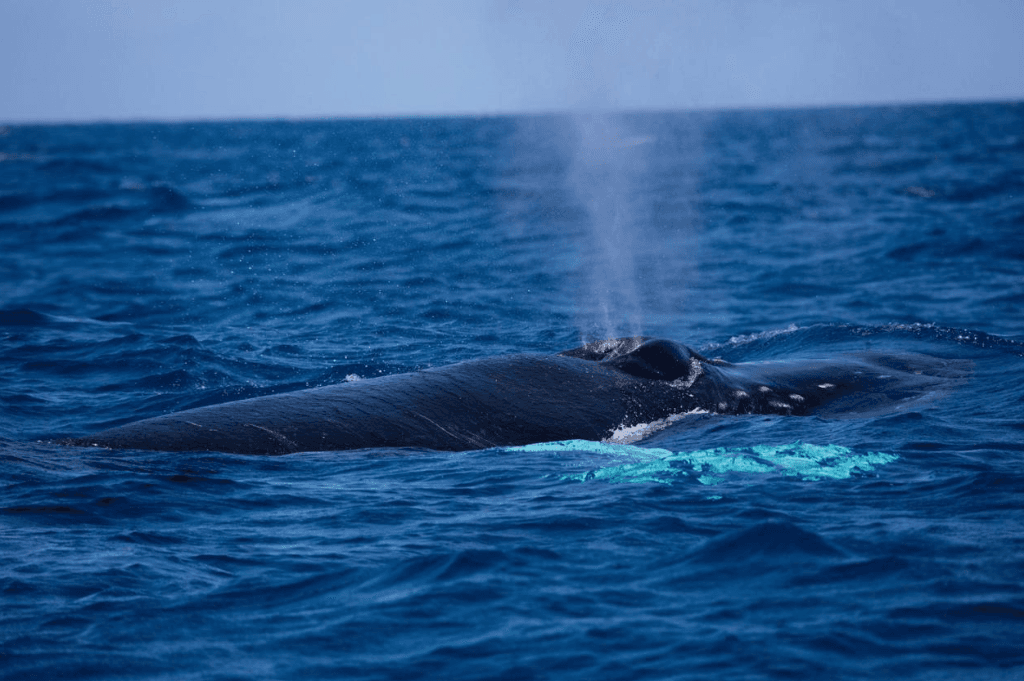
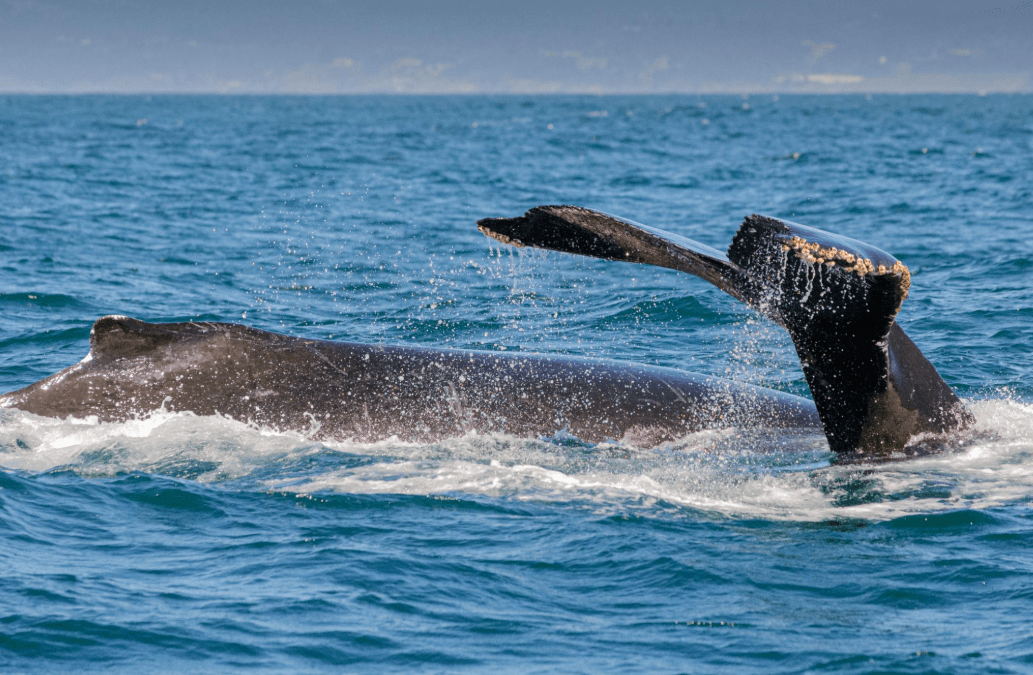
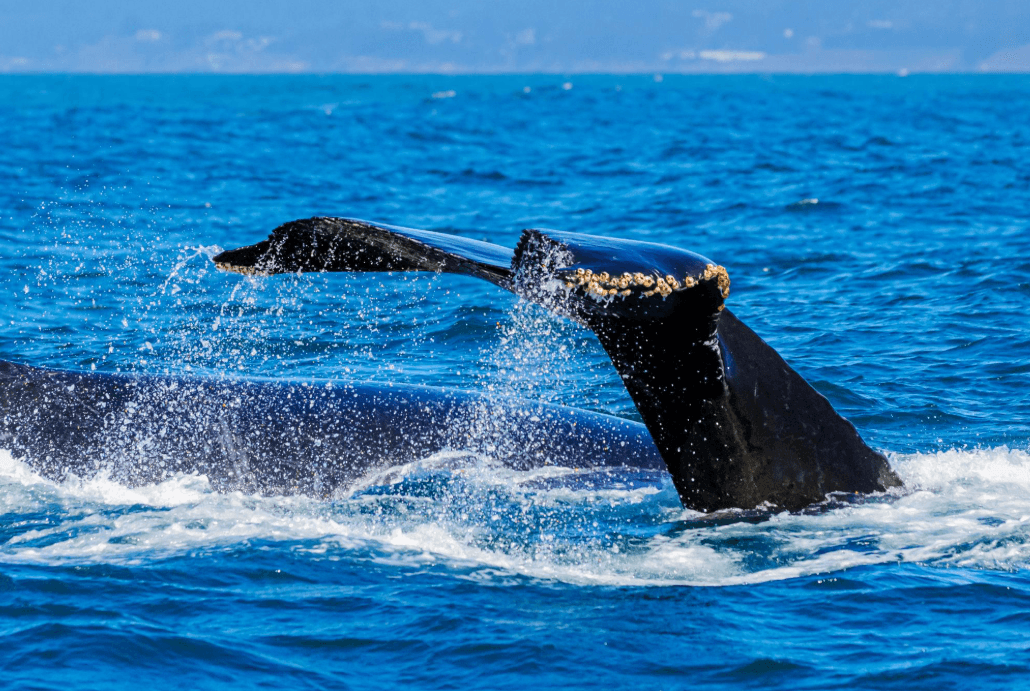
Whale watching usually emphasizes what people can see above the surface: a blow, a tail fluke, a breach, or a mother swimming with her calf.
Acoustic research reveals another part of whale life that visitors cannot normally experience directly from a tour boat.
Humpback whale vocalizations are complex biological signals, but scientists are still investigating how particular sounds function in different contexts. A recording may provide strong evidence that a whale vocalized without revealing the precise message or intention behind it.
This uncertainty is part of what makes marine science valuable. Each carefully documented recording can help researchers ask better questions and improve their understanding over time.
Frequently Asked Questions
How do scientists record humpback whale calls underwater?
Researchers use hydrophones connected to recording equipment. Depending on the study, these may be deployed from boats or installed at fixed underwater monitoring locations.
Can scientists hear humpback whales from the surface?
Some whale sounds may be detected using suitable underwater recording equipment, but ordinary human hearing above the surface is not a reliable way to monitor underwater vocal activity. Detection depends on sound frequency, distance, environmental conditions, and equipment.
Do all humpback whales produce songs?
Humpback whales produce a range of vocalizations. Elaborate songs are especially associated with males, while other calls are used in social contexts. Not every vocalization is a song.
Can whale calls tell scientists exactly how many whales are in Samaná Bay?
Not by themselves. Call counts may include repeated vocalizations from the same whale, while other animals may remain acoustically undetected. Estimating abundance requires additional data or appropriate methods.
What is a spectrogram used for in whale research?
A spectrogram displays how the frequency and intensity of sound change over time. Scientists use it to inspect, classify, and compare recorded vocalizations.
Can boat noise affect whale acoustic research?
Yes. Vessel noise and other background sounds can overlap with whale calls or make them harder to identify. Researchers consider these effects when analyzing recordings.
Conclusion
Scientists use hydrophones, spectrograms, and acoustic analysis to investigate humpback whale calls and vocal activity. These tools can reveal when detectable sounds occur, help researchers classify vocalizations, and complement visual observations of whales.
However, recordings must be interpreted carefully. The number of calls is not the same as the number of whales, and an acoustic detection does not automatically reveal a whale's identity or the meaning of its vocalization.
By combining sound recordings with appropriate research methods, scientists can improve their understanding of humpback whale activity and contribute to broader efforts to study and protect these remarkable animals.

Local explorer & expert guide in Visita Haitises.