Why Do Humpback Whales Have Such Long Flippers?
Humpback whales are famous for their enormous bodies, impressive tail flukes, and spectacular leaps out of the ocean. However, one of their most distinctive features is often overlooked: their exceptionally long pectoral flippers.
These flippers are much longer in proportion to body size than the pectoral fins of most other whale species. They help humpback whales maneuver underwater, adjust their direction, and control their movements in ways that make these marine mammals particularly fascinating.
But why did humpback whales develop such unusually long flippers How do these fins work, and what can visitors learn about them when observing whales in Samaná Bay, Dominican Republic?
This guide explores the anatomy, function, and evolutionary significance of humpback whale flippers.
How Long Are Humpback Whale Flippers?
Humpback whales have some of the longest pectoral fins relative to body size among whales. Their flippers can reach approximately one-third of their body length, although proportions vary between individuals.
An adult humpback whale can grow to around 40–60 feet (12–18 meters) long. Its long pectoral flippers can therefore measure several meters from base to tip.
These impressive dimensions help distinguish humpback whales from many other large whale species.
The flippers are not simply oversized paddles. They are complex anatomical structures containing bones, joints, muscles, and connective tissues. Their shape and flexibility help the whale control movement in the water.
What Are Humpback Whale Flippers Used For?
Humpback whale flippers perform several important functions. Their precise contribution depends on the animal's movement and activity.
1. Steering and maneuvering
One of the most important functions of pectoral flippers is helping a whale maneuver.
Humpback whales can adjust their flippers while swimming to influence their direction and body position. This helps them make turns and control movement in a three-dimensional environment.
For an animal weighing many tons, maneuverability is important. The ocean is not simply a straight path from one place to another. Whales must navigate changing conditions, interact with other animals, and move through water at different depths.
Their long flippers contribute to this flexibility.
2. Controlling body position
Pectoral flippers also help whales maintain control over their orientation in the water.
By adjusting the angle and position of their fins, humpback whales can influence how their bodies move during turns, dives, and other maneuvers.
The flippers work alongside the tail flukes and the movement of the body. No single body part performs every task independently.
3. Supporting complex movements
Humpback whales are known for a wide range of movements, including rolling, turning, and energetic surface behaviors.
Their unusually long flippers contribute to the control needed for many of these movements. Researchers continue to study how fin shape, flexibility, and movement interact with the water.
It is important not to assume that every fin movement has a specific social meaning. A whale's movements may depend on several factors, and their purpose is not always obvious to observers.
4. Helping with specialized feeding behavior
Humpback whales are filter feeders that consume small prey, including krill and small schooling fish.
Their feeding methods can involve coordinated body movements and changes in swimming direction. The pectoral flippers may contribute to maneuvering during these activities.
However, the flippers are not the primary structures responsible for filtering food. That task is performed by baleen plates inside the mouth, while the tail and body generate much of the propulsion needed for swimming.
What Makes Humpback Whale Flippers Different?
Several features make humpback whale pectoral flippers distinctive.
Their exceptional length
Many whales have pectoral fins that are relatively small compared with their bodies. Humpback whales stand out because their flippers are unusually long.
This proportion gives them a distinctive silhouette that can sometimes help observers identify the species.
Their irregular leading edges
The leading edge of a humpback whale's flipper has prominent bumps called tubercles.
These rounded structures are a characteristic feature of humpback whale anatomy. Researchers have investigated how tubercles influence water flow and hydrodynamic performance.
Studies of tubercled surfaces suggest that these structures can affect lift and flow separation. However, their exact benefits in a living humpback whale depend on several interacting factors, including fin shape, angle, and swimming conditions.
It would be too simplistic to claim that the bumps make the whale automatically faster in every situation.
Their flexible structure
Humpback whale flippers contain a skeletal structure that includes bones corresponding to the upper arm, forearm, wrist, and digits of other mammals.
These bones are adapted to support the flipper rather than a hand used for walking or grasping objects.
Muscles and connective tissues help control the fin's position and movement. Together, these structures allow the flipper to act as a flexible control surface in the water.
Why Did Humpback Whales Evolve Such Long Flippers?
The long flippers of humpback whales are an example of evolutionary adaptation.
Over many generations, inherited differences that influenced survival and reproduction could contribute to changes in body form. The result is a whale with pectoral fins that differ considerably from those of many other cetaceans.
Scientists study these differences by comparing anatomy, movement, and hydrodynamics across species.
Humpback whales' long flippers appear to contribute to their maneuverability and control in water. Their tubercled edges also provide a useful opportunity to study how natural structures interact with fluid flow.
Evolution does not mean that a body part developed for one simple reason. A structure can influence several aspects of an animal's performance, and the relative importance of those functions may vary.
Do Humpback Whales Use Their Flippers to Swim Forward?
Yes, their flippers can influence movement, but they are not the main source of forward propulsion during ordinary swimming.
Humpback whales primarily generate forward thrust through up-and-down movements of their powerful tail flukes.
The pectoral flippers contribute more to steering, maneuvering, and controlling body position. Their movement can also affect the forces acting on the whale as it travels through water.
Think of the tail as a major source of propulsion and the flippers as important control surfaces. This is a simplified comparison, but it helps explain why the whale needs both structures.
The tail and flippers work together rather than operating as entirely separate systems.
How Do Humpback Whale Flippers Help During a Dive?
When a humpback whale dives, its body angle and fin positions may change as it descends.
The flippers contribute to control and maneuverability while the tail provides propulsion. The whale can adjust its body position to travel through the water efficiently.
Observers from a boat may see the whale roll slightly, change direction, or lift part of its body before disappearing beneath the surface.
Not every dive looks the same. A whale's visible movements depend on its position, the depth of the water, and what it is doing at that time.
During a whale-watching excursion, it is generally impossible to determine the exact role of every fin movement from a brief surface observation.
Can Humpback Whales Use Their Flippers for Defense?
Humpback whale flippers are powerful structures, and they can be involved in physical interactions. However, it is important to distinguish what a fin can physically do from what researchers can confidently say about a particular behavior.
Humpback whales have been observed using their bodies and flippers during interactions with other animals. Some behaviors may occur in defensive or social contexts, but the meaning depends on the circumstances.
It is not accurate to assume that every flipper movement is an act of defense or aggression.
For visitors watching whales in the wild, the best approach is to observe from a safe, lawful distance and let trained guides explain what is known about the behavior.
Can You See Humpback Whale Flippers in Samaná Bay?
Samaná Bay in the Dominican Republic is a well-known seasonal destination for observing North Atlantic humpback whales.
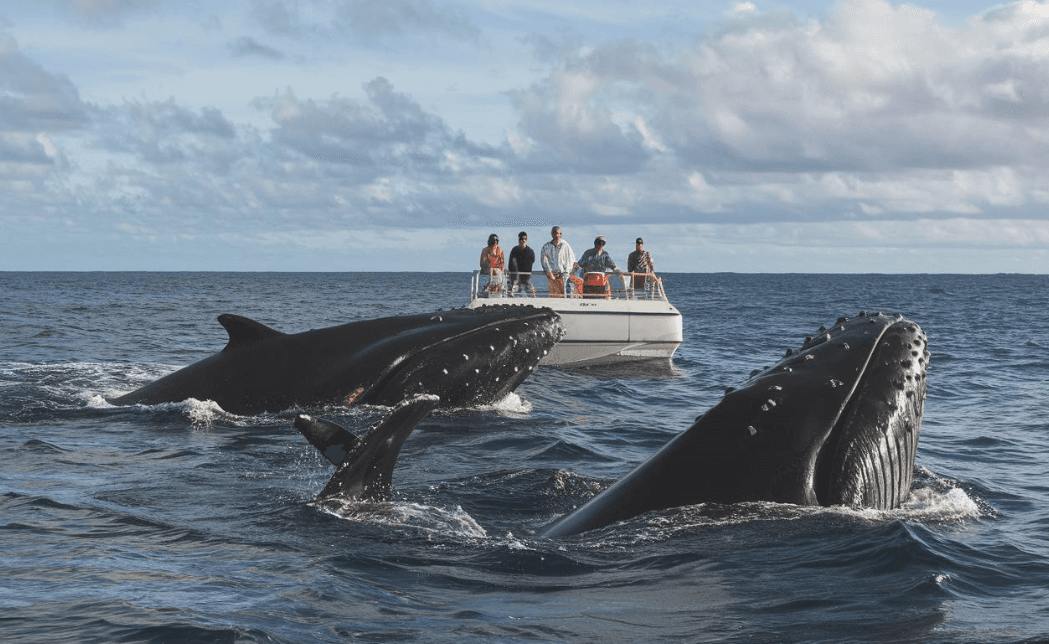
During the breeding season, visitors may see whales surfacing, diving, turning, and occasionally displaying their long pectoral flippers above the water.
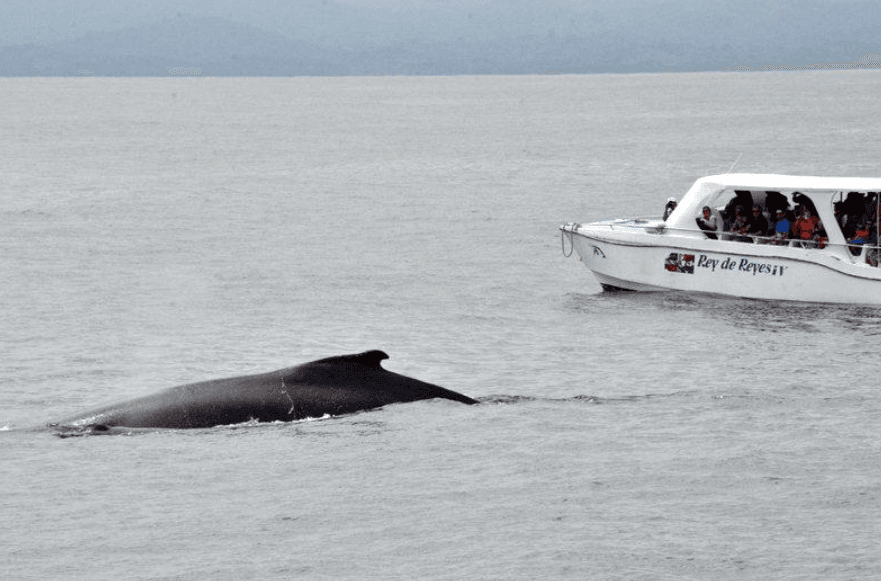
Some encounters offer a clear view of the fins. In others, only the whale's back, blow, or tail may be visible.
The appearance of a whale depends on its natural behavior and the conditions at sea. No tour can guarantee a particular display.
What to look for during a whale-watching trip
If a humpback whale appears near your vessel, look for these features when they are naturally visible:
- Long pectoral flippers: Notice their size relative to the whale's body.
- Pale or dark surfaces: Flipper coloration can vary between individuals.
- Rounded leading-edge bumps: These are the characteristic tubercles.
- Fin movement during turns: Observe how the whale adjusts its position in the water.
- Differences between the fins and tail: Pectoral flippers help with control, while the tail flukes provide much of the forward thrust.
You do not need to see every feature to appreciate the animal. Even a brief sighting can reveal something about the whale's anatomy.
How Are Humpback Whale Flippers Different From Their Tail Flukes?
The pectoral flippers and tail flukes have different shapes and functions.
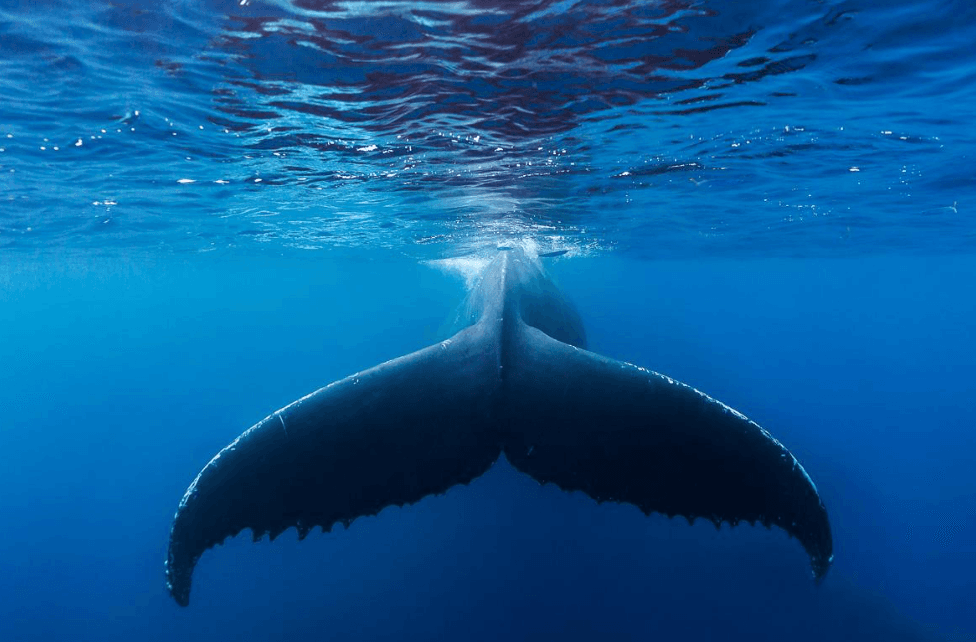
The flippers are located on the sides of the body and help with maneuvering and control. The tail flukes are at the rear of the whale and generate much of the force that propels it forward.
The flippers are paired structures, while the tail consists of two broad flukes joined at the central tail stock.
Both structures are essential to the whale's movement, but they do not perform identical jobs.
Understanding this difference makes it easier to interpret what you see during a whale-watching encounter.
Frequently Asked Questions
Why are humpback whale flippers so long?
Their unusually long pectoral flippers contribute to maneuverability and control in water. Their size and shape are distinctive anatomical adaptations that researchers continue to investigate.
How long are humpback whale flippers?
They can reach several meters in length and may measure roughly one-third of the whale's body length. Exact proportions vary between individuals.
What are the bumps on humpback whale flippers?
They are called tubercles. These rounded bumps along the leading edge are a characteristic feature of humpback whales and have attracted scientific interest because of their potential effects on water flow.
Do humpback whales use their flippers to move forward?
The flippers influence movement and control, but the tail flukes provide much of the propulsion during ordinary swimming.
Are humpback whale flippers used for feeding?
They may contribute to maneuvering during feeding activities, but the baleen plates inside the mouth perform the filtering that allows humpback whales to capture prey.
Can visitors see humpback whale flippers in Samaná Bay?
Yes, visitors may see the flippers during natural surface movements, although visibility varies. Whale sightings and particular behaviors cannot be guaranteed.
Final Thoughts
Humpback whales have exceptionally long pectoral flippers that distinguish them from many other whale species. These fins contribute to steering, maneuverability, and control, while their unusual leading-edge tubercles offer scientists an intriguing example of natural hydrodynamic design.
The flippers work together with the whale's powerful tail and flexible body to support movement through the ocean.
For visitors exploring Samaná Bay, learning about these distinctive fins adds another dimension to whale watching. The next time you see a humpback whale turn or raise a flipper above the water, you will have a better understanding of the remarkable anatomy behind that movement.
Always observe whales responsibly, follow your guide's instructions, and allow these animals to move freely in their natural environment.

Local explorer & expert guide in Visita Haitises.