Why Do Humpback Whales Sometimes Roll Sideways at the Surface in Samaná Bay?
Seeing a humpback whale in Samaná Bay, Dominican Republic, is an unforgettable experience. While many visitors hope to witness a spectacular breach or see a whale lift its tail, some encounters reveal a more subtle movement: a whale tilting its body and rolling sideways at the surface.
This movement can briefly expose part of the whale’s side, belly, or unusually long pectoral fin. It may happen once or be repeated during a longer encounter.
But why does a humpback whale roll sideways Is it trying to scratch its body, interact with another whale, or simply change position in the water?
The answer depends on the circumstances. Rolling is a movement rather than a single behavior with one universal explanation. Observing what happens before and after the roll can provide useful clues, although the whale’s exact motivation may remain unknown.
What Does Sideways Rolling Look Like?
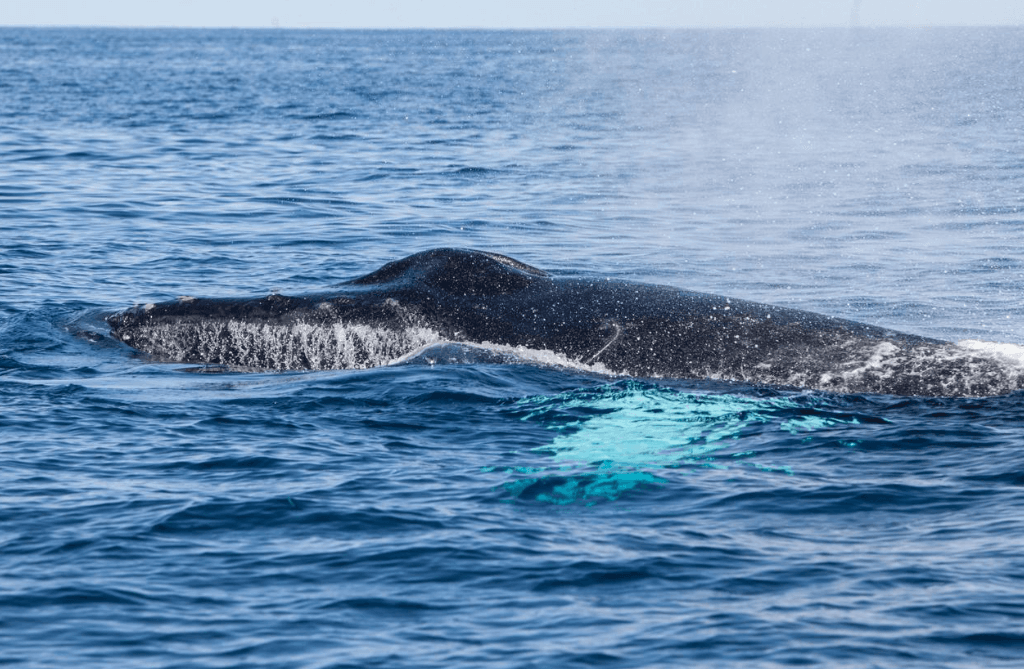
A humpback whale has a large, streamlined body designed for movement through water. When it rolls sideways, its body rotates around its lengthwise axis, causing one side to turn upward or become more visible at the surface.
The movement can be subtle. You might see the whale tilt its back, expose part of its pale underside, or lift one pectoral fin at an unusual angle.
In some cases, the roll is brief and occurs between ordinary surfacing movements. In others, the whale may remain at the surface long enough for observers to notice several changes in its body position.
The appearance depends on how much of the whale is above water, the angle of observation, and the surrounding sea conditions.
During a Samaná whale-watching trip, passengers may see only a small portion of the movement before the animal submerges again.
1. Rolling May Be Part of Ordinary Body Movement
One possible explanation is that the whale is adjusting its body position while moving through the water.
Humpback whales do not always maintain the same orientation. They can turn, tilt, and rotate as they change direction or move around objects and other animals.
A sideways roll may therefore occur as part of a broader movement rather than as a distinct display with a specific purpose.
For example, a whale might tilt while changing direction and then continue swimming normally. Without observing the complete sequence, it can be difficult to distinguish an ordinary body adjustment from a more deliberate behavior.
What to look for: Notice whether the whale continues traveling after the roll or returns to a more level position at the surface.
2. Could a Whale Roll to Rub Against Something?
Some marine mammals rub parts of their bodies against surfaces or objects. Physical contact can have different functions, including removing unwanted material or stimulating the skin.
However, seeing a humpback whale roll sideways does not prove that it is scratching itself.
To support that interpretation, an observer would need additional evidence, such as repeated contact with a particular surface or object. In open water, the whale may simply be rotating its body without rubbing against anything.
During whale watching in Samaná Bay, it is best to describe the visible movement accurately instead of assuming that the whale is trying to relieve an itch.
3. Rolling May Occur During Social Interactions
Humpback whales sometimes travel near other whales and display a range of movements during encounters. Their behavior may include changes in orientation, close approaches, separation, and movements at the surface.
A sideways roll observed during an interaction could be part of this larger sequence. Nevertheless, the roll alone does not establish that the whale is communicating, competing, courting, or playing.
The surrounding context matters. Guides and researchers may consider how many whales are present, how they are positioned relative to one another, and whether their movements appear coordinated.
If two whales are nearby, watch the whole interaction rather than interpreting one movement in isolation.
4. A Whale May Roll While Moving Its Pectoral Fins
Humpback whales have exceptionally long pectoral fins that help them maneuver in the water. Their movements can change the way the whale appears at the surface.
When a whale rolls, one pectoral fin may become more visible, while the other may disappear beneath the water. From a boat, this can make the animal appear to be raising a fin independently.
The distinction is important because rolling and pectoral-fin slapping are not the same behavior.
A roll involves rotation of the body. A pectoral-fin slap involves striking the water with a fin. Although these movements can sometimes occur near one another in a sequence, one should not automatically be mistaken for the other.
For visitors, identifying the movement correctly is a useful way to improve wildlife observation skills.
5. Could Rolling Be Related to Calf Care?
Samaná Bay is an important seasonal breeding and calving destination for North Atlantic humpback whales. During the season, visitors may have opportunities to observe mothers and their calves.
A mother may change her body orientation while swimming near her calf. However, a sideways roll by itself does not demonstrate that she is nursing, protecting, teaching, or playing with the young whale.
To understand a mother-and-calf encounter, observers need to consider the animals’ relative positions and their behavior over time.
The safest approach is to appreciate the interaction without assigning a specific purpose to every movement. Responsible whale-watching operators should also take particular care around mothers and calves and follow applicable viewing regulations.
6. Why Can Rolling Be Difficult to Recognize From a Boat?
A whale-watching boat provides a moving viewpoint, and passengers rarely see the entire animal underwater.
Waves can hide parts of the whale’s body. Changes in the boat’s position may alter the viewing angle, while sunlight and reflections can make the whale’s outline harder to distinguish.
A movement that looks like a roll from one angle may be difficult to interpret from another. For example, a whale turning away from the boat might reveal one side of its body before disappearing beneath the surface.
Repeated observation can help clarify what happened, but not every sighting provides enough information for a confident interpretation.
If your guide describes a movement as a roll, you can ask which visible features support that identification.
How to Distinguish Rolling From Other Humpback Whale Behaviors
Humpback whales perform several conspicuous surface movements. Learning their basic differences helps visitors describe what they see more accurately.
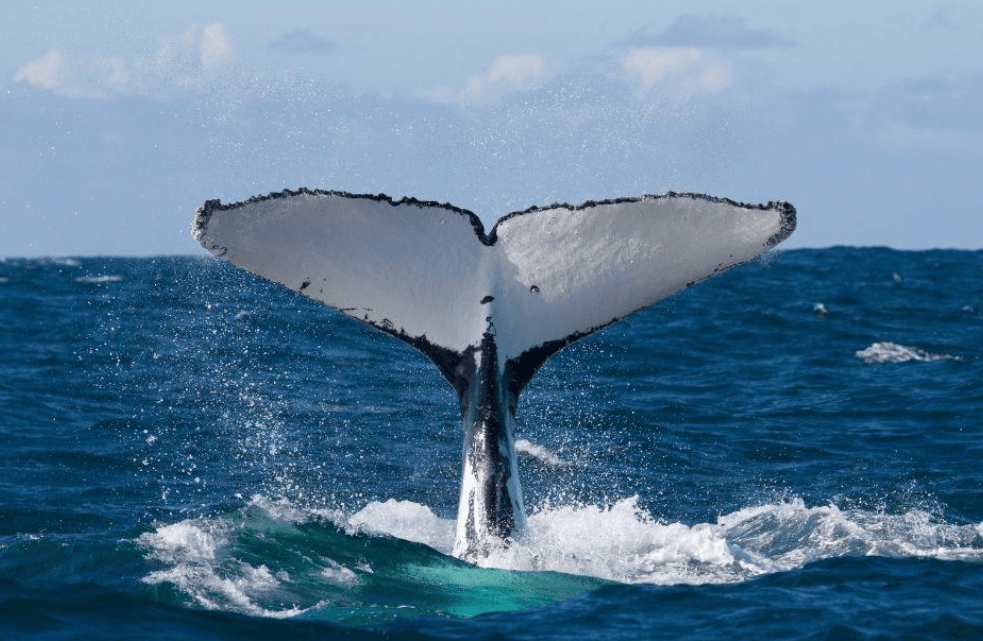
BehaviorWhat you may observeSideways rollingThe whale rotates its body, exposing part of its side or undersideBreachingThe whale launches much or most of its body out of the waterTail slappingThe whale strikes the water with its tail flukesPectoral-fin slappingThe whale raises a pectoral fin and strikes the water with itOrdinary turningThe whale changes direction, sometimes tilting its body during the maneuver
These descriptions focus on the visible action. They do not necessarily explain why the whale performs it.
For example, a breach may occur in several contexts, and a roll may have no obvious explanation to a human observer. Recognizing a behavior and identifying its purpose are two different tasks.
What Should You Do if You See a Humpback Whale Rolling?
If a whale rolls beside or ahead of your tour boat, the best response is to observe calmly and follow the crew’s instructions.
Here are a few ways to make the most of the encounter:
- Watch the entire sequence. Notice the whale’s body position before, during, and after the movement.
- Look for other whales. Nearby animals may provide context, although their presence does not automatically explain the roll.
- Listen to your guide. A knowledgeable guide can help identify visible behaviors and explain what is known about them.
- Avoid jumping to conclusions. A roll alone is not proof of illness, injury, play, or a social display.
- Keep a respectful distance. Never encourage the boat to approach or pursue a whale simply to obtain a closer view.
If you are taking photographs, capture a sequence when possible. Several images may help you understand how the whale’s orientation changed, even if the reason for the movement remains uncertain.
Is Sideways Rolling a Sign That a Whale Is in Trouble?
Not necessarily. A sideways roll is not, by itself, reliable evidence of distress or illness.
Whales naturally change their body positions and perform a variety of movements. Determining whether an animal is in difficulty requires more information than a single observation at the surface.
If a whale displays behavior that concerns you, tell the guide or crew rather than attempting to approach the animal. Trained personnel can follow appropriate procedures and avoid unnecessary disturbance.
Visitors should not attempt to touch a whale, enter the water to investigate, or direct the boat toward an animal that appears vulnerable.
Frequently Asked Questions
Why do humpback whales roll onto their sides?
A whale may roll as part of ordinary body movement, a change in orientation, or a broader interaction. The exact reason cannot always be determined from a brief surface sighting.
Does rolling mean a humpback whale is playing?
Not necessarily. Play is one possible interpretation in some contexts, but a roll alone does not establish that the whale is playing.
Can rolling help a whale scratch its skin?
Physical rubbing is possible in some animal behaviors, but an observed roll does not prove that a whale is scratching. Additional evidence of contact would be needed to support that explanation.
Is rolling the same as pectoral-fin slapping?
No. Rolling involves rotation of the whale’s body, while pectoral-fin slapping involves striking the water with a pectoral fin. They are distinct movements.
Can visitors see humpback whales rolling in Samaná Bay?
Visitors may observe a range of surface behaviors during the seasonal whale-watching period, but no particular movement is guaranteed on a tour. Sightings depend on the whales’ natural activity and the conditions on the day.
Final Thoughts
A humpback whale rolling sideways in Samaná Bay offers a fascinating glimpse of how these powerful marine mammals move and position their bodies.
The movement may occur during ordinary swimming, a change in orientation, or a broader social encounter. In some cases, the reason may remain unclear even when the movement itself is easy to recognize.
For whale watchers, the most useful skill is careful observation. Look at the whale’s full body movement, notice what happens around it, and avoid assigning a definite purpose without sufficient evidence.
Every encounter is different. By remaining patient and respecting the animals’ space, you can enjoy the remarkable experience of observing humpback whales in their natural environment.

Local explorer & expert guide in Visita Haitises.