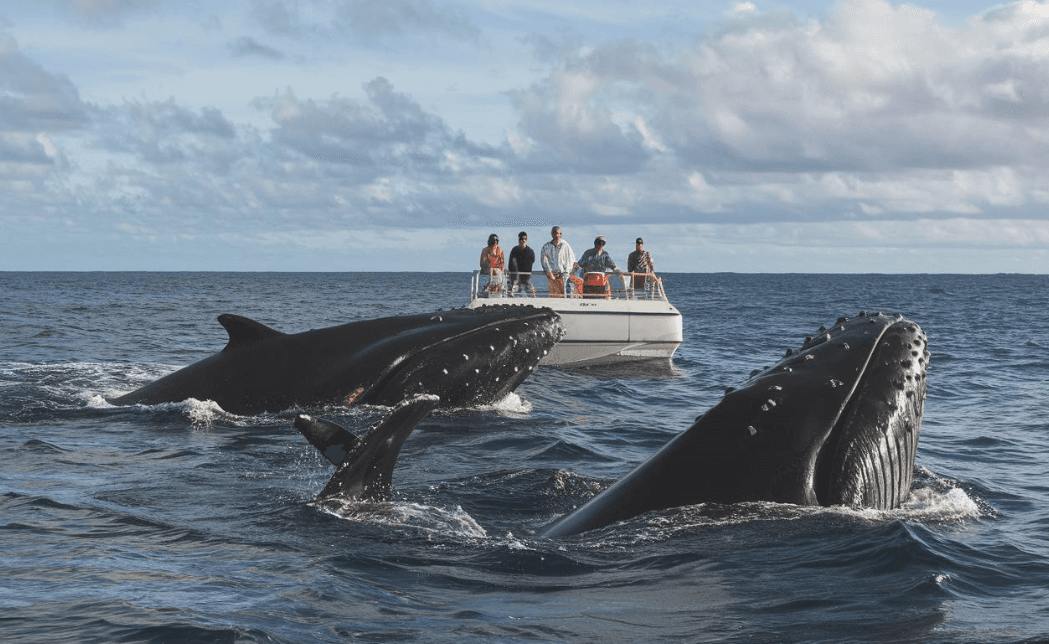
How Do Humpback Whales Navigate at Night?
The ocean does not become inactive when the sun sets. Beneath the dark surface, humpback whales continue moving through their marine environment, surfacing to breathe and traveling between locations even when visibility is limited.
But how do humpback whales navigate at night Do they rely on moonlight, sounds, memory, or other natural signals to find their way?
Scientists are still investigating the details of whale orientation. Humpback whales possess several sensory abilities that may help them move through darkness, but researchers have not established one single mechanism that explains all nighttime navigation.
For visitors interested in the humpback whales of Samaná Bay in the Dominican Republic, understanding nighttime behavior offers a glimpse into the lives of these animals beyond the daylight hours when whale-watching trips usually take place.
Can Humpback Whales Travel at Night?
Yes. Humpback whales can travel and carry out normal activities at night. They are not restricted to daylight hours, and darkness does not prevent them from moving through the ocean.
Like other marine mammals, humpbacks regularly surface to breathe. They may also change direction, adjust their depth, interact with other whales, and move between different areas after sunset.
Their nighttime activities depend on several factors, including their location, season, social circumstances, and current behavior.
A whale traveling through a familiar area may use different information from an animal moving through unfamiliar waters. However, researchers cannot always determine which sensory cues an individual whale uses during a particular journey.
1. Can Humpback Whales See in the Dark?
Humpback whales have eyes adapted to life underwater, where light behaves differently from how it does on land.
Their vision can help them detect objects and other animals when sufficient light is available. At night, the amount of available light depends on factors such as moonlight, cloud cover, water clarity, and depth.
Near the surface on a clear night, some natural light may remain available. Deeper underwater, light levels generally decrease, making visual information less useful.
It is therefore reasonable to expect that visual cues can contribute to nighttime behavior under suitable conditions, but vision alone cannot explain how humpback whales orient themselves in every situation.
Scientists do not have evidence that humpbacks depend on moonlight as their primary navigation system.
2. Does Hearing Help Humpback Whales Move at Night?
Sound is an important part of the underwater environment. Humpback whales produce sounds, and they can detect acoustic information in their surroundings.
Unlike light, sound can travel over considerable distances underwater, although its range and clarity depend on frequency, background noise, water conditions, and other factors.
Hearing may help whales detect other animals and remain aware of activity nearby. Acoustic information could be particularly useful when visual conditions are poor.
However, it is important to distinguish communication from navigation. A whale detecting another whale's call does not necessarily mean it is using that sound as a directional guide to a distant destination.
Researchers continue to investigate how whales use sound in different behavioral contexts, including social interactions and movement.
3. Could Humpback Whales Use Memory to Find Their Way?
Memory may be important for whales that repeatedly travel between seasonal habitats.
North Atlantic humpback whales migrate between feeding areas at higher latitudes and breeding regions in the Caribbean. These journeys involve substantial distances and recurring seasonal patterns.
A whale's previous experience may help it recognize familiar locations or follow established movement routes. Researchers can investigate these patterns by comparing sightings and tracking data across multiple years.
Memory is a plausible part of how experienced whales navigate familiar environments, but scientists cannot directly observe a whale's thoughts. They must infer possible mechanisms from movement patterns and other evidence.
It is also unlikely that memory alone explains every aspect of nighttime movement. Whales may combine information from several senses and environmental cues.
4. Does the Moon Influence Whale Navigation?
Moonlight changes nighttime illumination, and the lunar cycle affects many aspects of the marine environment.
For humpback whales, the moon may alter how much natural light is available near the surface. Lunar cycles can also influence other marine organisms, which may indirectly affect local ecological conditions.
However, these facts do not establish that humpback whales use the moon to navigate.
Scientists would need carefully collected evidence to show that whales consistently change their direction or movement in response to lunar cues, while accounting for other possible explanations.
At present, the contribution of moonlight to humpback whale navigation is not fully understood. It should be treated as a possible environmental influence rather than a confirmed primary navigation mechanism.
5. Can Humpback Whales Detect Earth's Magnetic Field?
Earth has a magnetic field that provides directional information to some animals. Researchers have investigated whether magnetic sensitivity may contribute to navigation in several marine species.
For humpback whales, however, the precise role of Earth's magnetic field in orientation remains uncertain.
The idea is scientifically interesting because whales undertake long seasonal journeys across large ocean areas. Yet a long migration by itself does not prove that an animal uses magnetic information.
To establish this mechanism, researchers need evidence that separates magnetic effects from other influences, such as learned routes, environmental conditions, and sensory information.
It is therefore more accurate to say that magnetic orientation is a possible area of investigation than to claim that humpback whales definitely use a magnetic compass to navigate at night.
6. Do Ocean Currents Help Humpback Whales Travel?
Ocean currents move water through the sea and can influence how animals move within it.
Currents may affect the energy required for swimming, the distribution of prey, and the conditions whales encounter along their routes. Water movement can therefore be relevant to travel, even though it does not necessarily tell a whale which direction to choose.
Humpback whales are active swimmers. Their movements are shaped by their own swimming behavior as well as by environmental conditions.
Scientists studying migration and movement consider several factors, including ocean conditions, habitat use, and the locations where whales are observed over time.
Currents may influence the journey, but they should not be described as a proven standalone navigation system for humpback whales.
7. Does Nighttime Navigation Change During Migration?
Humpback whales make seasonal migrations between feeding and breeding areas. North Atlantic humpbacks are known for traveling between northern feeding grounds and warmer Caribbean waters.
Migration is a broader process than nighttime navigation. It includes the overall seasonal movement between regions, while nighttime navigation concerns how a whale maintains orientation during darkness.
A whale may continue traveling after sunset as part of a much longer journey. Its orientation may depend on a combination of learned movement patterns, sensory information, and environmental conditions.
Researchers can study these journeys by attaching tracking devices under approved scientific protocols, recording sightings, and identifying individual whales over time.
These methods help reveal where whales travel and when they move. They generally cannot show exactly which sensory cue a whale used to choose every turn.
What Does Nighttime Whale Behavior Mean for Samaná Bay?
Samaná Bay in the Dominican Republic is a seasonal destination for North Atlantic humpback whales. During the Northern Hemisphere winter, whales gather in Caribbean waters for breeding and calving activities.
Although visitors usually observe whales during daylight excursions, the animals continue to live in the bay and surrounding waters outside those observation periods.
Nighttime behavior may include movement, surfacing, and interactions with other whales. The exact activities of an individual animal are difficult to determine without appropriate research equipment.
Visitors should not assume that every whale follows the same daily schedule. Some individuals may be traveling, while others may be engaged in different activities.
Understanding that whales remain active outside viewing hours can make a whale-watching trip more meaningful. It reminds visitors that a short encounter is only a glimpse of a much longer life in the ocean.
How Do Scientists Study Whales at Night?
Studying whales after dark is challenging because researchers cannot rely entirely on visual observations. They use several methods to investigate movement and behavior.
Satellite and electronic tracking
Specialized tags can record movement and, depending on the device, information such as location, depth, or activity. These records can help scientists examine travel patterns across day and night.
Tracking data show where an animal moved, but they do not automatically reveal which sensory mechanism guided it.
Acoustic monitoring
Hydrophones record underwater sounds and can help researchers study vocal activity and the surrounding acoustic environment.
Sound recordings may provide useful information when visual observation is limited. However, hearing a whale does not necessarily reveal its precise position or direction without additional data.
Photo identification
Humpback whales have distinctive tail-fluke markings that can help researchers recognize individuals. Comparing photographs collected at different times and places can reveal patterns of return and movement.
Photo identification is especially useful for long-term studies, although it depends on obtaining suitable photographs.
Combining multiple sources of evidence
Researchers can compare tracking records, acoustic observations, photographs, and environmental data to build a more complete understanding of whale behavior.
No single method answers every question. Scientists must be careful to separate what the data directly demonstrate from what remains a hypothesis.
Can People Observe Humpback Whales at Night?
Most visitors experience Samaná whale watching during daylight hours, when crews can observe whales and navigate according to local regulations and safety requirements.
Nighttime whale observation requires particular care. Darkness can reduce visibility and make it harder to assess distances, nearby animals, and vessel movements.
Visitors should use authorized tours and follow local rules rather than attempting to approach whales independently after dark.
Responsible whale watching is not about observing an animal at every possible hour. It is about seeing wildlife in a way that respects its natural behavior and minimizes disturbance.
Frequently Asked Questions
Are humpback whales active at night?
Yes. Humpback whales can travel, surface to breathe, and carry out other activities after sunset. Their behavior varies with location and circumstances.
Can humpback whales see in complete darkness?
They have eyes adapted to aquatic life, but vision depends on available light. It is not established that humpbacks can rely on vision alone in complete darkness.
Do humpback whales use sound to navigate?
Sound provides important information underwater and may help whales detect nearby animals and their environment. The precise role of sound in long-distance navigation is not fully understood.
Do humpback whales navigate by the stars?
There is insufficient evidence to conclude that humpback whales use stars as a primary navigation system.
Do humpback whales use Earth's magnetic field?
Magnetic orientation is a possible research question, but its role in humpback whale navigation has not been conclusively established.
Do humpback whales migrate at night?
Whales can continue traveling after sunset. The timing of individual movements varies, and researchers use tracking and long-term observations to study their journeys.
Final Thoughts
Humpback whales can move through the ocean at night even when visibility is limited. Their eyes, hearing, experience, and the surrounding environment may all contribute to how they interact with their surroundings, but the exact combination of navigation mechanisms remains an active area of scientific investigation.
For visitors to Samaná Bay, this is a reminder that the whales seen during a daytime excursion have lives that continue long after the boats return to shore.
By learning about nighttime whale behavior and supporting responsible wildlife observation, visitors can develop a deeper appreciation for these remarkable marine mammals and the habitats they depend on.

Local explorer & expert guide in Visita Haitises.