How Do Scientists Determine Whether Humpback Whales Return to the Same Social Partners in Samaná Bay?
Every winter, humpback whales visit the waters around Samaná Bay in the Dominican Republic as part of their seasonal movements through the North Atlantic. During the breeding season, researchers may observe whales traveling near one another, joining temporary groups, or appearing in the same area on different days.
These sightings raise an interesting scientific question: do individual humpback whales return to the same social partners, or are repeated encounters simply the result of several whales using the same breeding grounds?
Scientists investigate this question by identifying individual whales, comparing sighting records, and examining how often particular individuals are documented together. The process requires careful recordkeeping because seeing two whales together more than once does not automatically mean they have a lasting social bond.
Why Study Repeated Whale Associations?
Understanding recurring associations can help researchers investigate how humpback whales use breeding habitats and how their social encounters change over time.
Scientists may ask several questions:
- Are the same identifiable whales observed together on separate occasions?
- How much time passes between repeated sightings?
- Do the individuals appear together during one season or across multiple years?
- Are recurring associations more common than researchers would expect from random encounters?
- Could shared habitat use explain why the same whales are repeatedly seen together?
These questions are especially relevant in seasonal breeding areas such as Samaná Bay, where multiple whales may visit the same waters during overlapping periods.
However, evidence of recurring associations must come from actual identification and observation records. General knowledge about humpback whales cannot establish how frequently particular individuals reunite in Samaná Bay.
Step 1: Identify Individual Humpback Whales
Before scientists can determine whether two whales repeatedly appear together, they need a reliable way to recognize individual animals.
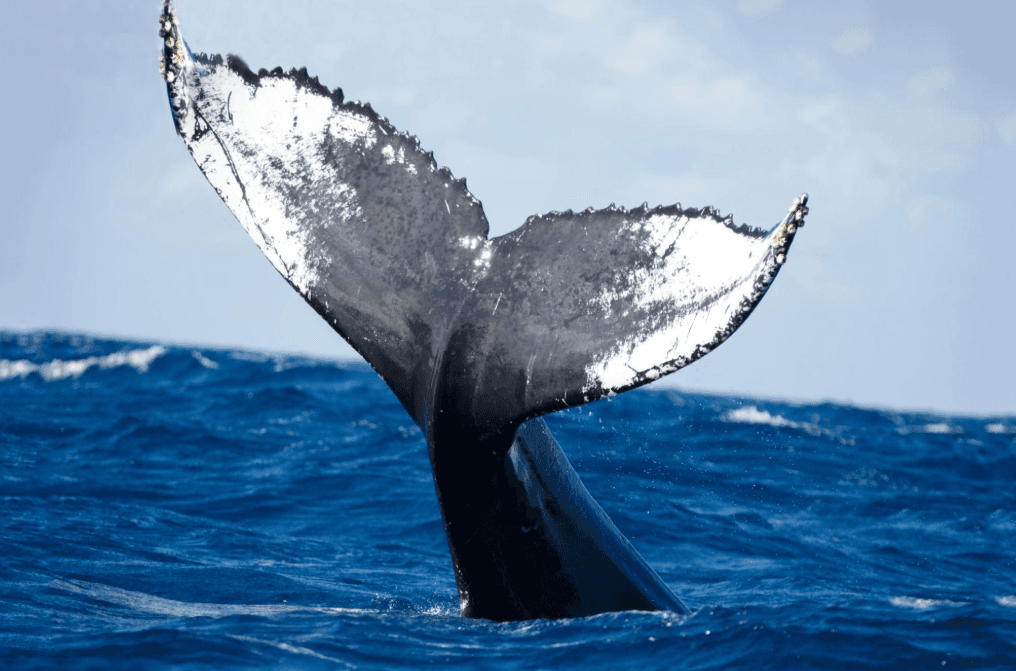
Tail-fluke photographs
The underside of a humpback whale's tail fluke often contains distinctive patterns of pigmentation, scars, and markings. Researchers photograph these features and compare them with images stored in identification catalogs.
When the photographs are clear enough, researchers may assign an identification number to an individual whale.
Recording identification confidence
Not every photograph provides enough detail for a confident match. A fluke may be partly submerged, blurred, or photographed under difficult lighting.
Scientists therefore need to distinguish confirmed identifications from uncertain matches. This helps prevent one whale from mistakenly being recorded as another individual.
Individual identification is the foundation of long-term association research: without it, repeated sightings cannot reliably establish which whales were present.
Step 2: Build a Record of Whale Sightings
Once individual whales can be recognized, researchers compile sighting records.
A useful record may include:
- Date and time of observation
- Geographic location
- Individual identification numbers
- Number of whales observed
- Approximate duration of the encounter
- Visible behavior and group composition
- Photograph quality and identification confidence
- Observation conditions, including sea state and visibility
These details help researchers compare encounters that occur on different dates.
For example, suppose researchers photograph Whale A and Whale B traveling near one another on one day. Several days later, both individuals are identified in another encounter. This provides evidence of a repeated association, provided the identifications and encounter records are reliable.
It does not, by itself, prove that the whales deliberately sought each other out.
Step 3: Compare Individuals Across Separate Encounters
Researchers can organize their records to identify which whales were observed together and how often.
Consider a hypothetical example:
- On February 3, Whale A and Whale B are photographed in the same group.
- On February 9, both whales are identified in another encounter.
- On February 18, Whale A is seen with Whale C, while Whale B is not detected.
The first two observations establish that A and B were documented together more than once. The third observation adds information about changing group composition but does not reveal whether B was absent from the area or simply missed during the survey.
A research team could compare this pattern with records for other identified whales to see whether certain pairs recur more frequently than expected.
These dates and individuals are illustrative only, not actual Samaná Bay research findings.
Step 4: Measure How Often Associations Recur
Scientists can use several approaches to describe repeated associations.
Number of shared sightings
The simplest measure is the number of documented encounters in which two identified whales appeared together.
This measure is easy to understand, but it can be misleading when some whales are observed much more often than others.
Proportion of shared observations
Researchers may compare the number of occasions when two whales were seen together with the occasions when one or both were observed under suitable survey conditions.
The denominator matters. A pair documented together three times may represent a different pattern if each whale was seen only four times than if each was seen in dozens of encounters.
Association indices
For suitable datasets, scientists can use statistical association indices to compare the frequency of co-occurrence between pairs of individuals.
Such measures help account for differences in observation opportunities, depending on the method used. They do not independently establish friendship, mating relationships, or deliberate reunions.
The best analytical approach depends on survey design, data completeness, and the specific research question.
Step 5: Separate Social Associations From Shared Habitat Use
One of the greatest challenges is determining why the same whales appear together repeatedly.
Samaná Bay attracts humpback whales during a seasonal period, so different individuals may use overlapping areas without maintaining a special relationship.
For example, two whales could be recorded near the same part of the bay because both are using suitable breeding habitat. If researchers repeatedly survey that location, the pair might appear together more often than whales using different areas.
To investigate this possibility, scientists may compare:
- The locations where each whale was observed
- The time intervals between encounters
- The number of times each individual was available for observation
- The distribution of other whales in the study area
- The likelihood of shared sightings under an appropriate comparison model
If a pair appears together more frequently than expected after relevant factors are considered, the records may provide stronger evidence of a recurring association.
Even then, researchers should describe the strength of the evidence carefully rather than assuming they know the whales' intentions.
Step 6: Investigate Associations Across Different Years
Long-term photo-identification records can help researchers determine whether the same individuals return to Samaná Bay in different breeding seasons.
If two whales are identified in the same season and both are documented again in a later year, scientists can investigate whether they also appear together again.
This requires more than confirming that both individuals returned to the region. Researchers must establish that the same whales were observed together during comparable encounters.
Long-term records may be incomplete because an individual can visit an area without being photographed or identified. A missing record is therefore not proof that a whale did not return.
Similarly, repeated association across two seasons does not necessarily demonstrate a continuous social partnership between those seasons.
What Can Prevent Scientists From Reaching a Firm Conclusion?
Several limitations affect research into recurring whale associations.
Missed sightings: Whales may remain underwater, move beyond the survey area, or go undetected in poor conditions.
Uncertain identification: Low-quality photographs can make individual matches difficult.
Unequal observation effort: Some whales may receive more attention or be photographed more often than others.
Changing group composition: Humpback whale groups can change while researchers are observing them, and a short encounter may not represent the full sequence of events.
Shared habitat: Whales using the same location may encounter one another repeatedly without maintaining a specific relationship.
Limited study duration: A small number of sightings may be insufficient to distinguish a recurring association from coincidence.
Accounting for these factors makes findings more credible and helps researchers avoid conclusions that go beyond the available evidence.
What Does a Repeated Association Actually Mean?
A repeated association is an observation-based description: two identified whales were documented together on multiple occasions according to a defined research method.
A social bond is a stronger interpretation that may require additional evidence about the consistency, duration, and nature of the relationship.
Scientists should distinguish between several levels of evidence:
- Co-occurrence: Two whales are observed in the same encounter.
- Repeated association: The same individuals are observed together on separate occasions.
- Consistent association: A well-supported dataset indicates that the pair repeatedly occurs together relative to suitable comparisons.
- Relationship interpretation: Researchers investigate what the pattern may mean, while considering alternative explanations.
This distinction is important because human terms such as friendship or loyalty can imply emotions and intentions that cannot be established from photographs alone.
How Does This Research Help Us Understand Samaná Bay?
Research on individual whales and their recurring associations can contribute to a broader understanding of how humpback whales use seasonal breeding habitat.
It may help researchers investigate whether certain areas support repeated encounters, how group composition changes, and whether identifiable whales return to the same region across years.
Such information can also contribute to conservation planning by improving knowledge of whale distribution and the importance of different habitats.
However, specific conclusions about recurring whale partnerships in Samaná Bay require appropriate local datasets. A general explanation of the research method should not be mistaken for evidence that particular pairs have been documented returning to one another.
Frequently Asked Questions
Do humpback whales return to the same social partners?
Scientists can investigate whether individually identified whales are repeatedly observed together. Whether those encounters represent a lasting social relationship depends on the evidence and alternative explanations.
How do researchers recognize the same whale in different years?
Researchers compare photographs of distinctive tail-fluke markings and other identifying features with established catalogs. Identification confidence depends on image quality and the distinctiveness of the features.
Does seeing two whales together twice prove they are companions?
No. Two sightings establish repeated co-occurrence when the identifications are reliable, but the whales may simply use the same habitat or follow similar seasonal movements.
Can researchers tell whether whales deliberately seek one another?
Repeated association records alone generally cannot establish intent. Researchers need additional evidence and must consider other explanations for the observed pattern.
Why are long-term whale records useful?
Long-term records allow scientists to compare sightings across seasons and years, investigate individual return patterns, and assess whether associations recur beyond a single encounter.
Conclusion
Determining whether humpback whales return to the same social partners in Samaná Bay requires reliable individual identification, detailed sighting records, repeated observations, and careful statistical comparisons.
Scientists can establish whether identified whales have been observed together more than once. Determining whether these encounters reflect a consistent social association requires stronger evidence and consideration of shared habitat, observation effort, and missed sightings.
For visitors to Samaná Bay, this research offers a deeper way to appreciate whale watching. Every encounter contributes to a broader picture of whale behavior, but responsible science depends on recording what can be observed and remaining cautious about what it might mean.

Local explorer & expert guide in Visita Haitises.