How Do Humpback Whales Keep Warm in Cold Water?
The ocean can be extremely cold, especially in the high-latitude regions where many humpback whales spend time feeding. Yet these enormous marine mammals can remain active in cold water, travel across different ocean environments, and survive conditions that would quickly cool an unprotected human body.
How do humpback whales keep warm Their main advantage is a thick layer of insulating fat called blubber. Combined with their large body size, specialized physiology, and adaptations for life in the ocean, blubber helps them conserve heat and maintain a relatively stable internal temperature.
Understanding how humpback whales manage body heat reveals an important part of their biology. It also helps explain how they can use different marine habitats throughout the year, including colder feeding areas and the warmer breeding waters around Samaná Bay in the Dominican Republic.
Are Humpback Whales Warm-Blooded?
Yes. Humpback whales are mammals, which means they are endothermic: they produce metabolic heat and regulate their internal temperature rather than simply matching the temperature of the surrounding water.
This is important because water can carry heat away from the body much faster than air under comparable conditions. A whale swimming in cold water must limit heat loss while continuing to support essential functions such as movement, digestion, and other metabolic processes.
Unlike fish that rely heavily on environmental temperatures to regulate many aspects of their body function, humpback whales maintain an internal environment suited to mammalian life.
Their ability to regulate temperature is one of the adaptations that allows them to occupy a wide range of ocean habitats.
What Is Blubber, and How Does It Keep Whales Warm?
Blubber is a thick layer of fat beneath a whale's skin. It is one of the most important adaptations that helps humpback whales conserve heat in cold water.
Unlike ordinary body fat considered only as an energy reserve, blubber also performs a crucial insulating role.
1. Blubber slows heat loss
The water surrounding a whale may be considerably colder than its internal body temperature. Heat naturally moves from warmer areas toward colder ones.
Blubber contains relatively little water compared with many other body tissues and has properties that make it an effective thermal insulator. It slows the transfer of heat from the whale's body to the surrounding water.
This helps the whale maintain its internal temperature without having to replace all lost heat continuously.
2. Blubber provides an energy reserve
Blubber also stores energy that whales can use when food is limited.
This is especially important for humpback whales because their annual cycle includes long migrations and periods when they feed little or not at all. Stored energy supports the demands of travel, reproduction, and other bodily functions.
Insulation and energy storage are related benefits, but they are not identical. Blubber helps reduce heat loss while also providing an important reserve of stored energy.
3. Blubber cushions the body
The layer also contributes to the whale's body structure and provides cushioning beneath the skin.
Its thickness and composition can vary with factors such as age, reproductive condition, season, and nutritional status. A whale's body condition is therefore more complex than simply having as much fat as possible.
How Thick Is Humpback Whale Blubber?
Humpback whale blubber can be several centimeters thick and may be thicker in some body regions than others. There is no single thickness that applies to every whale.
Its thickness can vary according to the animal's size, age, health, reproductive state, and the location on its body where it is measured.
Scientists study blubber using measurements from appropriately collected samples, stranded animals, and other research methods. These observations help researchers understand body condition, energy reserves, and aspects of whale physiology.
It is not possible to estimate a whale's precise blubber thickness simply by looking at it from a boat.
The important point is that blubber forms a substantial insulating layer that supports life in water, including cold marine environments.
Why Does a Large Body Help Humpback Whales Stay Warm?
Humpback whales are enormous animals, and their size contributes to heat conservation.
As an animal becomes larger, its volume generally increases more quickly than its external surface area. Since heat exchange with the surrounding environment occurs largely across the body surface, a large animal can lose less heat relative to its total body volume than a much smaller animal with a similar shape.
This relationship is known as the surface-area-to-volume effect.
For humpback whales, a large body combined with insulating blubber provides an advantage in cold water.
However, size alone is not enough to explain temperature regulation. Blubber, circulation, metabolic heat production, and other physiological processes all contribute to keeping the animal warm.
Do Humpback Whales Have Fur to Keep Warm?
No. Adult humpback whales do not have a thick coat of fur like polar bears or sea otters.
Instead, they rely primarily on blubber for insulation.
Like other cetaceans, humpback whales have mostly smooth skin that helps reduce drag as they move through the water. Some hairs may occur around the mouth area, particularly in early development, but these do not form a protective coat comparable to the fur of land mammals.
For whales, a thick layer of insulating fat is much better suited to their aquatic lifestyle than a dense fur coat would be.
This is one example of how different mammals have evolved different ways to manage heat depending on their environments.
How Do Humpback Whales Regulate Heat While Swimming?
Insulation is only part of the story. Humpback whales also have physiological systems that help control how heat moves around their bodies.
Blood circulation
Blood transports heat throughout the body. By regulating blood flow to different tissues, mammals can influence how much heat reaches the skin and how much is retained in the body.
In marine mammals, circulation plays an important role in managing heat exchange, particularly around body regions that are more exposed to the surrounding water.
The exact mechanisms vary between tissues and situations, so temperature regulation should not be attributed to one process alone.
Heat exchange near the fins and tail
The pectoral flippers and tail flukes are less insulated than the thick central body and can be important areas for heat exchange.
Marine mammals have vascular arrangements that can help regulate heat transfer in certain body regions. These systems are studied across different species to understand how they balance heat conservation with other physiological needs.
It would be too simplistic to say that every fin or tail always functions as a heat radiator. Heat exchange depends on blood flow, environmental conditions, and the animal's physiological state.
Metabolic heat
Like other mammals, humpback whales produce heat through normal metabolic activity. Their muscles generate heat as they work, and other body processes also contribute to internal heat production.
Blubber helps conserve this heat, reducing the amount that escapes into the ocean.
Together, metabolism, insulation, and circulation allow a humpback whale to maintain a suitable internal temperature.
How Do Humpback Whales Handle Different Ocean Temperatures?
Humpback whales migrate between different regions of the ocean during their annual cycle.
Many North Atlantic humpbacks feed during warmer months in higher-latitude waters where prey can be abundant. During winter, many travel toward warmer breeding areas in the Caribbean, including waters around Samaná Bay.
These environments differ in temperature, food availability, and the whale's main activities.
Blubber remains important in both settings, but its role is not limited to cold water. It also stores energy needed for migration and reproduction.
A whale does not simply stop needing insulation when it enters warmer water. Instead, its body continues to regulate heat while adapting to changing environmental conditions.
Why Do Humpback Whales Travel to Warmer Waters?
The seasonal movement of humpback whales is closely linked to reproduction and food availability.
Many North Atlantic humpbacks spend the warmer part of the year feeding in northern waters. During the winter breeding season, they migrate to lower-latitude areas where mating and calving occur.
Samaná Bay is one of the Caribbean locations associated with this seasonal presence.
The whales' movement between feeding and breeding areas illustrates how their physiology supports a demanding life cycle. Stored energy helps sustain them during periods when feeding is reduced, while insulation supports temperature regulation in changing conditions.
It is important not to assume that warm breeding waters are necessary because adult humpbacks cannot survive cold water. These whales are well adapted to cold environments. Their seasonal movements reflect a broader reproductive and ecological pattern.
Do Baby Humpback Whales Have Blubber?
Yes. Blubber is important for young humpback whales, too.
A newborn calf enters an aquatic environment where maintaining body temperature is essential. Its insulating layer helps reduce heat loss while its body grows and develops.
Calves also rely on their mothers' energy-rich milk for nourishment. The milk supports growth and helps the calf build its own body tissues and energy reserves.
Early life is a demanding period because a calf must grow, develop coordination, and become increasingly capable of surviving in the ocean.
The precise condition of a calf's blubber changes as it develops. Its thermal needs and energy use are influenced by growth, activity, and environmental conditions.
Can Humpback Whales Get Too Warm?
Yes. Maintaining a stable internal temperature involves balancing heat production and heat loss. An animal that generates heat through metabolism and muscle activity must also be able to release excess heat when necessary.
Blubber is an effective insulator, but insulation does not mean a whale cannot exchange heat with its environment.
Physiological mechanisms, including blood circulation, help marine mammals manage this balance. Conditions such as water temperature, activity level, and the animal's physical state can influence thermal demands.
The details of heat regulation in free-swimming humpback whales are not always easy to measure directly. Scientists use physiological studies and observations across marine mammals to investigate these questions.
What Does Blubber Tell Scientists About Whale Health?
Blubber is useful to researchers because it stores energy and contains biological information.
When samples can be collected safely and ethically, scientists may examine blubber to investigate body condition, hormones, contaminants, and other indicators relevant to whale health.
Changes in blubber condition can provide clues about nutrition and energy reserves. However, a single measurement cannot reveal everything about an individual whale's overall health.
Researchers combine different kinds of evidence to understand how whales respond to changing food availability, environmental conditions, and other pressures.
These studies can help inform conservation work and improve understanding of the challenges humpback whales face throughout their lives.
Can You See Blubber During Whale Watching in Samaná Bay?
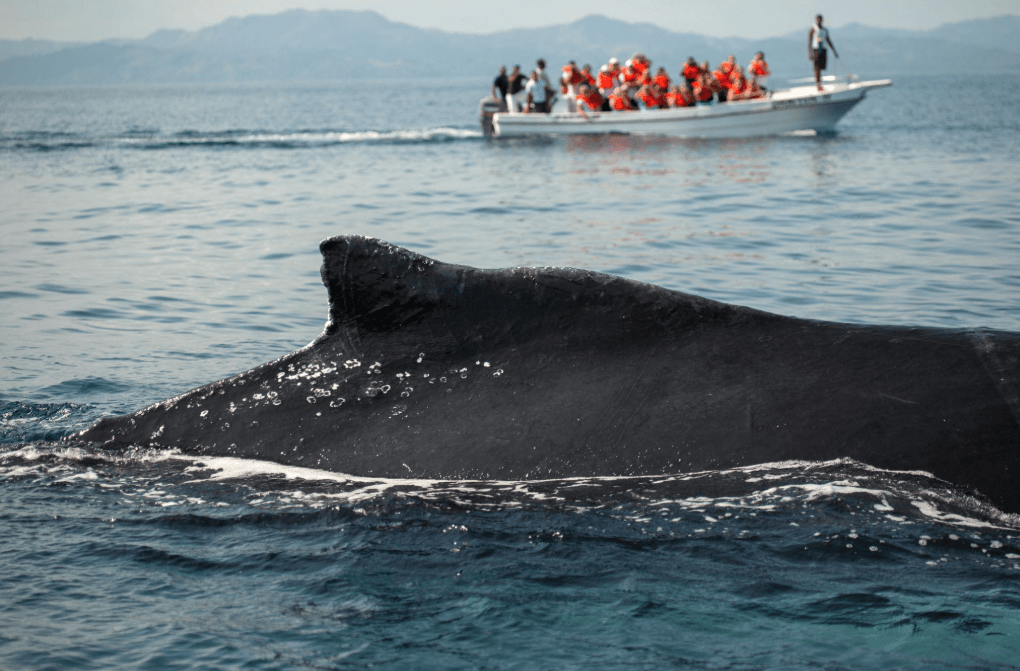
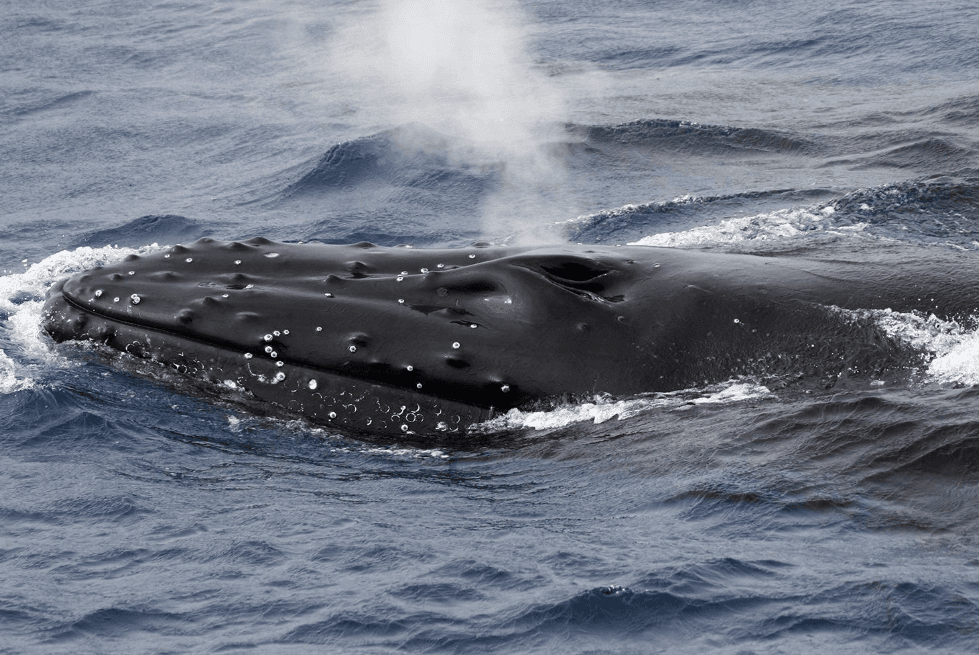
Usually, no. During a typical whale-watching excursion, visitors see the whale's outer surface rather than the blubber beneath its skin.
A whale may surface, show its back, or lift its tail, but these views do not provide a direct measurement of the insulating layer.
Nevertheless, learning about blubber makes a whale encounter more meaningful. The animal you see at the surface has a specialized body that helps it conserve heat, store energy, and survive in different marine environments.
If you visit Samaná Bay during the whale season, a knowledgeable guide may explain how the whales' annual movements connect northern feeding grounds with Caribbean breeding areas.
Choose a responsible operator that follows applicable wildlife regulations and gives whales room to move naturally.
Frequently Asked Questions
How do humpback whales keep warm in cold water?
They rely mainly on blubber, a thick insulating layer beneath the skin. Their large body size, metabolism, and physiological heat-regulation mechanisms also help maintain a stable internal temperature.
Do humpback whales have fur?
Adult humpback whales do not have a thick fur coat. Their main insulation comes from blubber beneath the skin.
Is blubber the same as ordinary fat?
Blubber is a specialized layer of fatty tissue in marine mammals. It stores energy and provides insulation, while also contributing to body structure and cushioning.
Do humpback whales need warm water to survive?
No. Humpback whales are adapted to a wide range of ocean temperatures. Their seasonal migrations are linked to reproduction and food availability, not simply an inability to tolerate cold water.
Do baby humpback whales have blubber?
Yes. Blubber helps calves conserve heat, while their mothers' energy-rich milk supports growth and development.
Can blubber thickness show whether a whale is healthy?
Blubber measurements can provide useful information about body condition, but they are not a complete health assessment. Researchers consider multiple indicators when studying an individual whale.
Final Thoughts
Humpback whales stay warm through a combination of insulating blubber, large body size, metabolic heat production, and physiological temperature regulation. Their blubber also stores the energy they need for migration, reproduction, and periods when feeding is limited.
These adaptations help humpbacks survive across diverse ocean environments, from cold northern feeding grounds to warmer Caribbean breeding areas such as Samaná Bay.
The next time you observe a humpback whale, remember that much of what allows it to thrive is hidden beneath the surface. Understanding these adaptations offers a deeper appreciation of whale biology and the importance of protecting the ocean habitats on which these animals depend.

Local explorer & expert guide in Visita Haitises.