Why Do Humpback Whales Sometimes Disappear Behind Waves and Reappear Nearby?
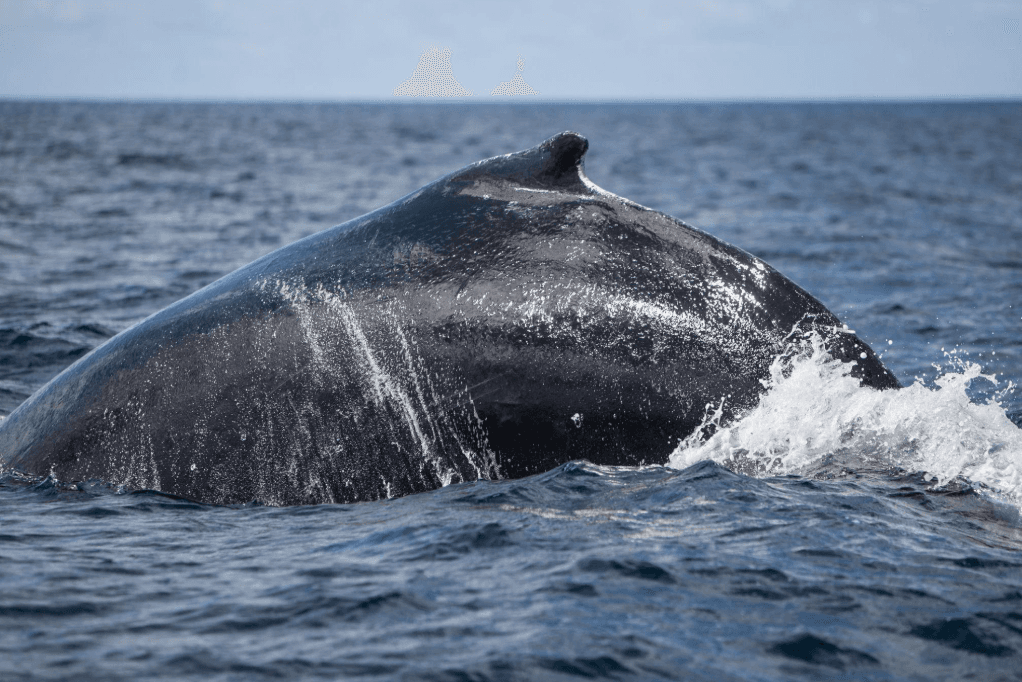
Imagine watching a humpback whale in Samaná Bay, Dominican Republic. You see its back rise above the water, follow its movement for a few seconds, and then suddenly lose sight of it. A moment later, the whale appears again nearby.
It can seem as though the animal has vanished and returned. In reality, the interruption may have more to do with the shape of the sea and your viewing position than with a dramatic change in the whale’s behavior.
Ocean waves constantly change the view between a whale and a person watching from a boat. A wave crest can temporarily block the animal, while a small change in the boat’s position or the whale’s movement can restore the view.
Understanding this effect helps visitors interpret whale sightings more accurately and enjoy the experience without making assumptions about what happens underwater.
Why Can Waves Hide a Humpback Whale?
The ocean surface is not a flat window into the water. It rises and falls, creating changing sightlines between observers and wildlife.
When a wave rises in the space between a boat and a whale, it may block the observer’s view of the animal. If the whale remains near the surface, it can become visible again when the wave passes or the viewing angle changes.
This is similar to watching a person from behind a low hill: the person has not necessarily disappeared, but the obstruction prevents you from seeing them.
The effect can be particularly noticeable when a whale is far away. At greater distances, a relatively small interruption in the sightline may be enough to hide the visible portion of the animal.
In Samaná Bay, as in other whale-watching destinations, the experience depends on both the whale’s movements and the conditions affecting the observer’s view.
1. Wave Crests Create Temporary Visual Barriers
A wave crest is the raised portion of a passing wave. Depending on its height and the observer’s position, it can obstruct the view of a whale beyond it.
Consider a whale moving near the surface. Its back may be visible above the surrounding water, but a rising wave between the animal and the boat can block that outline.
When the wave moves onward, the whale may become visible again.
The observer can therefore experience three stages:
- The whale is visible above the water.
- A wave interrupts the sightline.
- The whale becomes visible again after the obstruction clears.
This sequence does not require the whale to dive and resurface. Temporary obstruction alone can explain the change in visibility.
However, observers should not automatically assume that every disappearance is caused by a wave. The animal may also have submerged or moved away from the original viewing area.
2. The Boat and Whale Are Moving Independently
A whale-watching boat and a humpback whale do not occupy fixed positions relative to one another.
The boat may rise and fall with the waves while the whale moves through the water. These movements continually change the viewing angle.
For example, a passenger may see a whale clearly when the boat is near the top of a swell. As the boat moves down the swell, a wave crest may block the same sightline.
The whale might still be swimming near the surface, but the passenger can no longer see it from that position.
A change in viewing angle can also reveal the whale again without any dramatic movement by the animal.
This is one reason two people on the same boat may describe the same encounter differently. Their seating positions, eye levels, and viewing directions may give them different sightlines.
3. Distance Makes Disappearances More Noticeable
A whale seen nearby may be easier to track because more of its body is visible and its movements are easier to distinguish.
A distant whale, by comparison, may appear as a small shape against the water. When only a limited portion of the animal is visible, a wave can hide the entire outline from view.
Distance also makes it harder to judge whether the whale has moved sideways, changed depth, or surfaced again in a different position.
This matters when interpreting sightings during whale-watching trips. A whale that reappears a short distance from its previous visible position may not have traveled as far as it appears to have done.
Without continuous visibility or additional observations, the precise underwater path cannot be established from the two sightings alone.
4. The Whale May Actually Have Submerged
Although waves can hide a whale, genuine submergence is another possible explanation.
Humpback whales regularly move between the surface and underwater environments. A whale that disappears from view may have submerged as part of its normal movement.
The challenge is distinguishing this from a temporary obstruction.
If the animal disappears behind a visible wave crest and reappears after the wave passes, obstruction is a reasonable possibility. If the whale’s body is observed moving below the surface, there is clearer evidence of submergence.
In many real encounters, however, the view is incomplete. An observer may not see the exact moment the whale disappears.
The most accurate description is sometimes simply that the whale was temporarily out of sight. This acknowledges what was observed without claiming certainty about what happened underwater.
5. Light and Reflections Can Make a Whale Seem to Disappear
Wave obstruction is not the only factor that affects visibility. Sunlight, reflections, and contrast can also influence how easily a whale can be seen.
When bright glare covers the water, the outline of a distant whale may become difficult to distinguish. A small change in the angle of sunlight or the observer’s position can make the same animal easier or harder to see.
Reflections can be especially distracting when the sea surface is uneven, because light appears in changing patterns across the waves.
In such conditions, a whale may seem to disappear even when part of its body remains visible.
This is why sighting conditions should be considered alongside animal movement when describing an encounter.
6. Why Does the Whale Sometimes Reappear Nearby?
When a whale becomes visible again, it may appear close to the place where it was last seen. Several explanations are possible.
The obstruction has passed. The whale may have remained near the surface while a wave blocked the view. Once the wave moved, the same animal became visible again.
The viewing angle has changed. The boat may have moved with the swell or changed position, creating a clearer line of sight.
The whale has continued swimming. During the interval when it was not visible, the animal may have moved along its underwater path. It can then surface in a nearby area.
The whale has surfaced again. If it submerged, it may later return to the surface within the observer’s field of view.
These explanations are not mutually exclusive. A whale may move underwater while the boat also changes position and waves interrupt the sightline.
Without continuous observation, it is usually impossible to identify the exact combination of factors responsible for a particular sighting.
Can Whale Watchers Predict Where the Whale Will Reappear?
Not reliably from a single disappearance.
A whale’s previous visible position may offer a useful reference point, but it does not reveal the animal’s exact underwater location or direction at every moment.
The whale may continue along its previous course, change direction, or remain submerged for a period. Meanwhile, waves and the boat’s movement can change where observers should look.
Rather than predicting an exact reappearance point, responsible observers can keep track of the last confirmed sighting and scan the surrounding water without assuming the whale must emerge in a particular place.
Guides may use experience and the sequence of observations to help passengers follow a sighting. Nevertheless, any prediction should account for uncertainty.
How Whale-Watching Guides Help Passengers Follow a Whale
Experienced whale-watching guides can help passengers understand what is visible and where to look next.
They may point out the last location where the whale was clearly seen, explain how waves affect the view, and help passengers distinguish a confirmed sighting from an uncertain shape on the water.
Guides can also remind passengers that a whale disappearing from sight is not necessarily an emergency or an indication of unusual behavior.
The goal is to observe wildlife responsibly, not to pursue every temporary disappearance.
Boat operators should follow applicable whale-watching rules and maintain appropriate distances. A whale that becomes difficult to see should not automatically prompt a chase or a rapid maneuver intended to regain a closer view.
Patient observation often produces a more rewarding experience while allowing the animal to move naturally.
Practical Tips for Visitors Watching Whales in Samaná Bay
If a humpback whale disappears behind waves during your trip, a few simple habits can help you follow the encounter.
Keep your eyes on the general sighting area
Remember where the whale was last clearly visible. Continue observing the surrounding water rather than focusing on one exact point.
Watch the waves as well as the whale
Notice whether a wave crest is moving between your boat and the animal. This can help explain why the view is interrupted.
Avoid assuming that every disappearance is a dive
A whale may submerge, but it can also become hidden by waves, glare, distance, or a changing viewing angle.
Listen to your guide’s instructions
Guides can help passengers coordinate their attention and understand the limits of the sighting. Follow instructions that support safe and responsible wildlife viewing.
Be patient
Not every whale encounter provides a continuous view. A brief appearance followed by a later reappearance can still be a memorable experience.
Take photographs without losing awareness
Photographs can help preserve a sighting, but watching only through a camera screen may cause you to miss the wider movement of the whale and the surrounding water.
Can Photographs Prove That a Whale Disappeared Behind a Wave?
A single photograph usually captures only one moment. It may show the whale clearly, show a wave crest blocking the view, or fail to capture the animal at all.
A sequence of photographs or video may provide stronger evidence of how visibility changed. Even then, the recording may not reveal what happened underwater.
For example, a photograph taken before a disappearance and another taken after the whale reappears cannot necessarily establish whether the animal remained near the surface between the two moments.
When sharing images online, captions should describe what the evidence supports. “A humpback whale reappears beyond a wave crest” is more precise than claiming that the animal followed a particular underwater route without supporting observations.
Accurate descriptions make wildlife content more trustworthy and help readers understand the limitations of photographs.
What Does This Teach Us About Whale Watching?
Whale watching is an exercise in observing wildlife through an incomplete view of the natural world.
People see only the portion of a whale that is exposed above the surface and not hidden by waves, reflections, or distance. The animal’s underwater movements remain largely out of sight.
A brief disappearance therefore has several possible explanations. Understanding those possibilities helps visitors avoid confusing an interruption in visibility with a confirmed behavioral event.
It also encourages a more thoughtful approach to wildlife tourism. Rather than expecting every movement to be predictable, visitors can appreciate the encounter while recognizing that the whale is moving independently in its natural environment.
Frequently Asked Questions
Why do humpback whales disappear behind waves?
Wave crests can temporarily block the sightline between the whale and the observer. The whale may become visible again when the wave passes or the viewing angle changes.
Does a whale always dive when it disappears?
No. It may submerge, but waves, glare, distance, and the movement of the boat can also make it temporarily invisible.
Why does the whale reappear near its previous location?
It may have remained near the surface while a wave blocked the view, or it may have moved underwater and surfaced nearby. The visible sequence alone may not reveal which explanation is correct.
Can waves hide a large humpback whale completely?
Yes. Depending on the distance, wave conditions, and the portion of the whale exposed above water, a wave can obstruct the entire visible outline from a particular viewing position.
Is this common during whale watching in Samaná Bay?
Temporary interruptions in visibility are possible whenever waves, distance, and viewing angles affect a sighting. Conditions vary from trip to trip, so the frequency of this experience should not be assumed to be the same every day.
What should passengers do when a whale disappears?
Continue observing the general area, listen to the guide, and avoid assuming that the whale must reappear at an exact point. Follow the operator’s responsible wildlife-viewing practices.
Does a whale’s reappearance prove it has changed direction?
No. A change in the visible position may result from the whale’s movement, the boat’s movement, or a change in the sightline. More observations are needed to determine the animal’s actual path.
Conclusion
When a humpback whale disappears behind waves and reappears nearby, the interruption may be caused by a changing sightline rather than a dramatic change in behavior. Wave crests, boat movement, distance, glare, and the whale’s own movements can all influence what an observer sees.
The most important lesson is to separate what is directly visible from what remains uncertain. A temporary disappearance does not, by itself, prove that the whale dived, changed direction, or traveled a particular distance.
For visitors enjoying whale watching in Samaná Bay, patience and careful observation make these encounters easier to understand. Even when the view is interrupted, the experience offers a valuable reminder that the ocean is constantly moving—and that a whale’s life extends far beyond the brief moments it spends in sight.

Local explorer & expert guide in Visita Haitises.