Why Do Humpback Whales Sometimes Surface in the Same Place Repeatedly in Samaná Bay?
During a Samaná whale-watching trip in the Dominican Republic, you may notice something intriguing: a humpback whale surfaces, disappears beneath the water, and then appears again in almost the same area a few minutes later.
For visitors, this can feel as though the whale has chosen one particular spot in the bay. But is it deliberately returning to the same location, following a route, or simply remaining nearby?
Humpback whales can surface repeatedly within a limited area for several reasons. Their movements may be related to breathing, resting, social interactions, traveling with other whales, or staying close to a calf. However, seeing several surfacings in one place does not automatically reveal the whale’s exact purpose.
Understanding these patterns adds another layer of excitement to whale watching in Samaná Bay, where seasonal visitors can observe humpbacks in their natural marine environment.
1. The Whale May Be Moving Slowly Through the Area
One possible explanation is that the whale is moving slowly rather than remaining stationary.
Humpback whales do not always travel in a straight line at a constant speed. They may change direction, adjust their pace, or follow a winding path. If a whale swims through a relatively small area, it may surface several times within the same general viewing zone.
From a whale-watching boat, these appearances can create the impression that the animal keeps returning to one location.
In reality, the whale may be making steady progress underwater between surfacings. The boat’s own movement can also affect how passengers perceive the whale’s position.
What visitors can observe: Watch whether the whale’s back and dorsal fin appear progressively farther along the horizon. Small changes in position may reveal movement that is difficult to recognize during a single surfacing.
2. The Whale May Be Resting or Moving at a Relaxed Pace
Humpback whales may spend periods moving slowly or resting at the surface, depending on their activity and circumstances.
When a whale moves slowly, repeated appearances in a limited area become easier to notice. It may surface, submerge, and reappear nearby without making a substantial change in its overall position.
However, it is important not to assume that every whale remaining in one area is sleeping or resting. Determining a whale’s activity requires more than simply observing where it surfaces.
For whale watchers, patience is useful. Observing the animal over several minutes may provide more clues about whether it is traveling, moving slowly, or interacting with another whale.
3. A Mother and Calf May Stay Relatively Close Together
Samaná Bay is known as a seasonal breeding and calving area for North Atlantic humpback whales. During the breeding season, visitors may have opportunities to observe mothers traveling with their young calves.
A mother and calf may remain relatively close to one another as they move through the water. If their movement is slow, the pair may surface repeatedly within the same general area.
Calves are developing their swimming abilities and learning to function in the marine environment. Staying close to the mother is an important part of their early life.
Nevertheless, repeated surfacing alone does not prove that a calf is present. Visitors should look for the animals’ overall size, proximity, and coordinated movement, while relying on experienced guides to help interpret the sighting.
If a mother and calf are observed, responsible whale-watching practices are especially important. Boats should follow applicable regulations and maintain the required distance rather than attempting to approach the pair.
4. Social Interactions May Keep Whales in One Area
Humpback whales sometimes interact with other whales during the breeding season. These interactions can include traveling together, approaching one another, changing direction, and displaying behaviors at the surface.
When two or more whales remain in the same general area, passengers may see repeated surfacings near one another.
Some groups may also change their spacing or direction as the interaction develops. The resulting pattern can look different from the movement of a whale traveling alone.
Not every gathering has the same explanation. The presence of several whales does not automatically mean they are mating, competing, or forming a lasting social group.
Whale-watching tip: Look at the spacing and movement of the animals over time. Notice whether they surface close together, separate, or appear to move in the same direction. These observations provide useful context without requiring you to guess their exact intentions.
5. The Whale May Be Following a Particular Route
A whale that appears repeatedly in the same area may be traveling along a route that brings it through that part of the bay.
Natural features, water movement, and the whale’s current activity may influence how it moves through the surrounding environment. However, a few sightings in one place are not enough to establish that a whale follows a fixed route.
It is also difficult for passengers to judge underwater movement accurately from a moving boat. The whale may cover more distance beneath the surface than its repeated appearances suggest.
For this reason, guides and researchers consider broader movement patterns and multiple observations rather than treating one repeated sighting as proof of a regular route.
6. The Boat May Make the Whale Seem More Stationary Than It Is
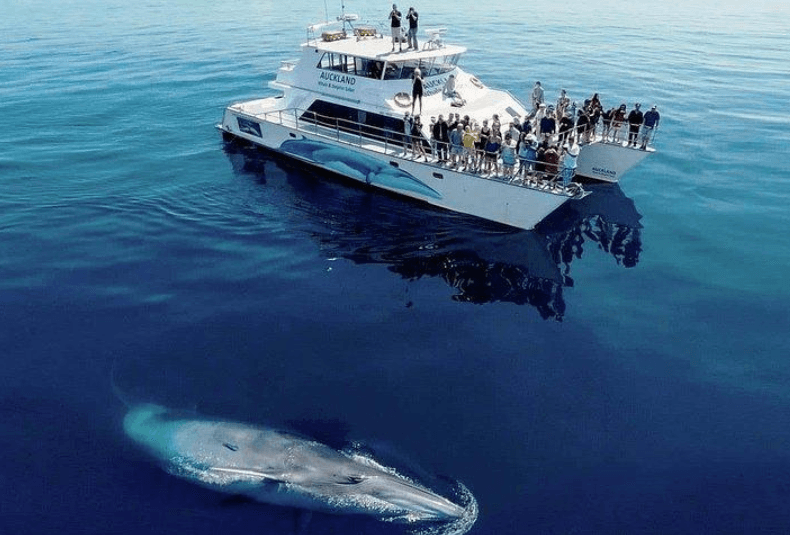
An important factor in whale watching is the position of the observation platform.
A boat may drift, turn, or change speed while passengers watch a whale. If both the boat and the whale are moving, it can be difficult to judge the animal’s actual direction and distance.
For example, a whale may surface ahead of the boat, disappear, and then appear off one side. To passengers, it might seem to have returned to the original location, even though the relative positions have changed.
This is why experienced guides often help passengers track the whale’s movement across the water instead of focusing on one isolated point.
Remember that a whale surfacing near the same part of the horizon is not necessarily returning to an exact underwater location.
7. Could Underwater Conditions Influence Where a Whale Surfaces?
The underwater environment can influence how marine animals move through an area. Water depth, currents, and the surrounding habitat may be relevant to movement patterns.
However, it would be inaccurate to claim that a humpback whale repeatedly surfaces in one particular place because of a specific current, depth, or underwater feature without evidence.
A whale may have several reasons for remaining in a general area, and its behavior can change throughout an encounter.
During a Samaná whale-watching excursion, guides may describe local conditions that are relevant to the sighting. Their explanations can provide useful context, but the precise reason for a whale’s movement may not always be known.
How to Tell Whether a Whale Is Returning or Simply Staying Nearby
Although it is difficult to determine a whale’s exact intentions from a boat, you can make more careful observations by watching the whole sequence.
Here are a few things to consider:
- Direction of movement: Does the whale appear progressively farther along the horizon, or does it remain within a small area?
- Time between appearances: How long does the animal remain underwater before surfacing again?
- Other whales: Is another whale nearby, particularly a calf or an animal moving in coordination with it?
- Changes in behavior: Does the whale continue traveling, slow down, change direction, or display visible surface activity?
- Your boat’s position: Has the boat drifted or changed direction since the previous sighting?
These details can help you describe what happened more accurately. They cannot, by themselves, prove why the whale surfaced in that location.
Why Repeated Surfacing Makes Whale Watching More Interesting
A single sighting can be exciting, but repeated appearances give visitors more time to appreciate the whale’s natural behavior.
You may begin to notice differences in the animal’s movement, how it interacts with nearby whales, or how its body appears when it surfaces. You may also become better at anticipating where to look after the whale disappears.
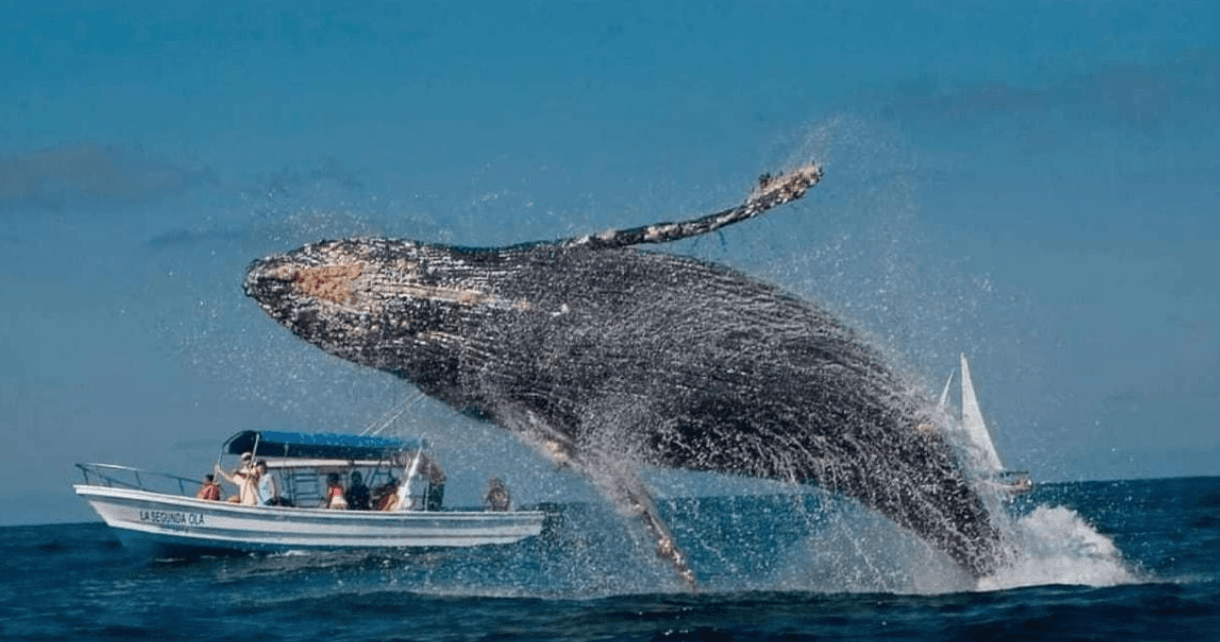
Repeated surfacing creates opportunities to learn without needing to see a dramatic breach or tail slap.
It is worth remembering that wild whales do not perform on a schedule. They may remain visible for several minutes, disappear for longer periods, or move beyond the viewing area entirely. Every encounter is different.
The best approach is to remain patient, listen to your guide, and appreciate the sighting without expecting the whale to return to the same spot.
Responsible Whale Watching in Samaná Bay
When whales repeatedly surface in one area, passengers may be tempted to ask the boat operator to move closer or follow the animal aggressively.
Responsible whale watching puts the welfare of the whales first. Operators should follow applicable local regulations, maintain required distances, manage boat speed appropriately, and avoid actions that disturb the animals.
Visitors can help by following the crew’s instructions, remaining calm during sightings, and avoiding attempts to attract or touch the whales.
If a whale disappears underwater, allow the crew to manage the observation. Chasing its last known position is not necessary to enjoy the experience and may interfere with responsible viewing.
Frequently Asked Questions
Why does a humpback whale keep surfacing in the same spot?
The whale may be moving slowly, traveling through a small area, interacting with other whales, or staying near a calf. The boat’s movement can also make the animal appear more stationary than it is.
Does repeated surfacing mean a whale is resting?
Not necessarily. Slow movement and repeated surfacing may be consistent with resting, but location alone cannot establish what the whale is doing.
Do humpback whales follow the same route through Samaná Bay?
Individual whales may move through the same general areas, but repeated sightings from one boat trip do not establish a fixed route. Reliable conclusions require broader observations.
Why do two whales sometimes surface close together?
They may be traveling or interacting with one another. Their exact relationship and purpose cannot always be determined from a brief encounter.
How long should I watch a whale before drawing conclusions?
There is no fixed time that guarantees an accurate interpretation. Watching several surfacing events provides more context than a single appearance, but some behaviors remain difficult to interpret without additional information.
Final Thoughts
When a humpback whale repeatedly surfaces in the same part of Samaná Bay, the pattern can offer an interesting glimpse into its movement and behavior.
The animal may be traveling slowly, staying near another whale, resting, or simply passing through a relatively small area. The movement of the boat can also affect how the sighting appears to passengers.
Rather than assuming that the whale has chosen a specific spot for a particular reason, pay attention to its direction, nearby animals, and changes in behavior. These observations make a Samaná whale-watching trip more educational and rewarding.
The next time a humpback whale disappears and resurfaces nearby, take a moment to watch the full sequence. You may discover that the most interesting part of the encounter is not just where the whale appears, but how it moves through its natural environment.

Local explorer & expert guide in Visita Haitises.